
How to become a teacher after 12th is one of the most searched career questions in India — and with good reason. Teaching is a highly respected, stable, and fulfilling career that offers government job security, excellent salaries, and the ability to make a lasting social impact. Whether you want to teach in a primary school, become a government TGT/PGT teacher, a KVS or NVS faculty member, or even a college lecturer or professor, the journey begins right after Class 12. This complete Matrise guide walks you through every step — stream-wise paths (Science, Arts, Commerce), the best courses to enrol in, government exams to crack, salary expectations, and a clear step-by-step roadmap for 2026.
How to Become a Teacher After 12th: The Complete Roadmap
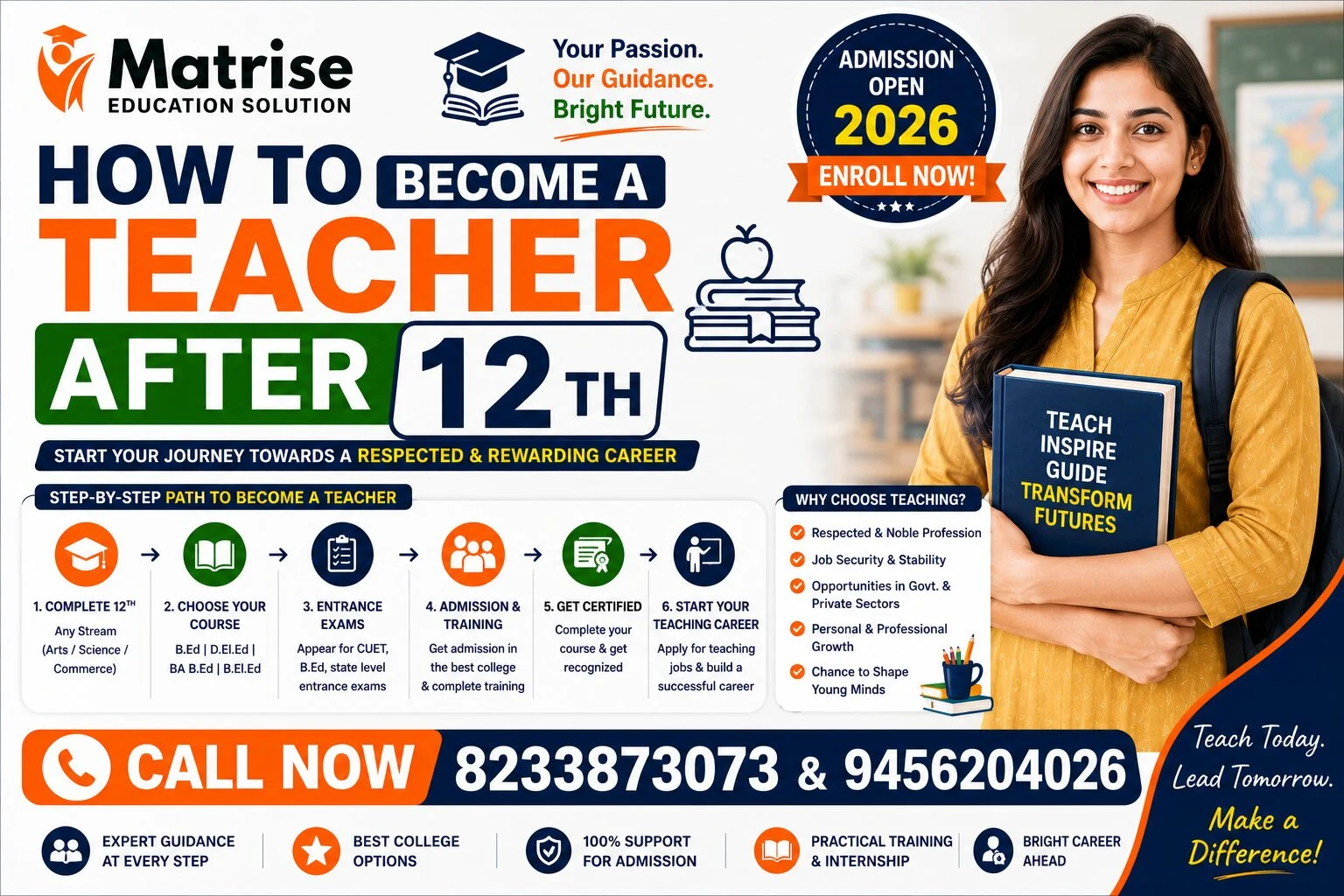
The road to becoming a teacher after 12th has a clear structure — but many students get confused about which course to take first, when to appear for TET, and how many years it will take. Let us break it down into four essential stages:
-
1
Clear Class 12 (Any Stream)
Your first step is completing Class 12 from a recognised board with at least 50% marks. Arts, Science, and Commerce students can all become teachers — the stream determines which subject you will eventually teach.
-
2
Complete Graduation (BA / B.Sc / B.Com)
Enrol in a 3-year graduation programme in your preferred subject. Alternatively, join a 4-year integrated B.Ed programme directly after 12th to save time.
-
3
Complete Teacher Training (B.Ed / D.El.Ed / B.El.Ed)
This is the mandatory professional qualification for teaching. As per NCTE (National Council for Teacher Education), a B.Ed, D.El.Ed, or equivalent is required to teach in any recognised school in India.
-
4
Clear CTET / State TET
After getting your B.Ed/D.El.Ed, clear the Teacher Eligibility Test. CTET is conducted by CBSE and applies to central school teaching. State TET applies to state government schools.
-
5
Apply for Government Teacher Jobs
Apply through KVS, NVS, state PSC, or DSSSB with your degree, B.Ed certificate, and TET/CTET scorecard. Get selected through written exam + interview.
Best Courses to Become a Teacher After 12th
Choosing the right course is the most important decision on your teaching journey. Here is a complete breakdown of every teacher training course available after 12th — from integrated programmes to postgraduate paths:
| Course | Duration | Entry Point | Teaching Level | Best For |
|---|---|---|---|---|
| B.El.Ed | 4 years | After 12th (direct) | Primary (Class 1–8) | Students who decide early to teach primary level |
| BA B.Ed (Integrated) | 4 years | After 12th (direct) | Secondary (Class 6–10) | Arts stream students targeting TGT |
| B.Sc B.Ed (Integrated) | 4 years | After 12th (direct) | Secondary (Class 6–10) | Science stream students targeting TGT |
| D.El.Ed | 2 years | After 12th / Graduation | Primary (Class 1–5) | Primary school teaching (govt. schools) |
| B.Ed (2-year) | 2 years | After Graduation | Secondary/Senior Secondary | TGT (Class 6–10) and PGT (Class 11–12) |
| M.Ed | 2 years | After B.Ed | College / Teacher Educator | Teacher educators, college-level education roles |
| UGC NET / CSIR NET | Exam (no fixed time) | After Master’s degree | College Lecturer / Professor | Those targeting college/university teaching |
The fastest route to becoming a school teacher after 12th is the 4-year integrated programme. For example, a BA B.Ed Course or B.Sc B.Ed Course directly after 12th saves you one year compared to doing graduation and B.Ed separately.
How to Become a Government Teacher After 12th: Stream-Wise Guide
Your 12th stream largely determines which subjects you will eventually teach. However, the core process — graduation + B.Ed + TET — remains the same across all streams. Here is the stream-specific breakdown:
For Science Stream Students (PCB / PCM)
Science students can become Maths teachers, Physics teachers, Biology teachers, Chemistry teachers, or Zoology teachers. This is one of the most in-demand teaching categories in India.
| Goal | Path After 12th | Exam to Clear |
|---|---|---|
| Maths / Science TGT (Classes 6–10) | B.Sc (Maths/Science) + B.Ed Admission | CTET Paper II / State TET |
| Physics / Chemistry / Biology PGT | B.Sc + M.Sc in Subject + B.Ed | CTET Paper II / State TET + UPSC/KVS |
| Zoology / Botany Teacher | B.Sc (Zoology/Botany) + B.Ed | State TET / CTET Paper II |
| Science PGT (KVS / NVS) | B.Sc + M.Sc + B.Ed | CTET + KVS/NVS Exam |
| Integrated Route (Fast) | B.Sc B.Ed (4 years) directly after 12th | CTET / State TET after course |
For Arts Stream Students
Arts students have some of the richest options — from English teachers and History teachers to Political Science and Psychology teachers. Government schools across India have a consistent demand for Arts teachers.
| Goal | Path After 12th | Exam to Clear |
|---|---|---|
| English Teacher (TGT) | BA (English Hons) + B.Ed | CTET Paper II / State TET |
| History / Political Science Teacher | BA (History/Pol Sci) + B.Ed | CTET / State TET |
| Primary Teacher (PRT) | D.El.Ed (after 12th) + Graduation | CTET Paper I / State TET Paper I |
| English Lecturer / Professor | BA + MA (English) + UGC NET | UGC NET |
| Integrated Arts Route | BA B.Ed (4 years) after 12th Arts | CTET Paper II after course |
For Commerce Stream Students
Commerce students can target Accounts, Economics, Business Studies, and Statistics teaching positions. Government schools and KV schools regularly recruit Commerce teachers.
| Goal | Path After 12th | Exam to Clear |
|---|---|---|
| Commerce / Economics TGT | B.Com / BA (Economics) + B.Ed | CTET Paper II / State TET |
| Commerce PGT (KVS) | B.Com + M.Com + B.Ed | KVS PGT Exam + CTET |
| Economics Lecturer (College) | BA Economics + MA Economics + NET | UGC NET / SET |
How to Become a Primary School Teacher After 12th
Becoming a primary school teacher is one of the most accessible teaching paths. It is ideal for students who love working with young children and prefer a more immediate career entry.
Clear Class 12 (50%+)
Any stream (Arts/Science/Commerce) is accepted for primary teacher paths.
Enrol in D.El.Ed or B.El.Ed
D.El.Ed (2-year) after graduation or B.El.Ed (4-year) directly after 12th. Both are NCTE-recognised for primary teaching.
Clear CTET Paper I or State TET Paper I
Paper I covers Classes 1–5. Visit CTET Official Website for notifications. State-specific teachers need the respective state TET.
Apply for PRT Posts
Apply for Primary Teacher (PRT) posts in KVS, NVS, or state govt. schools. Check KVS Recruitment Portal for current openings.
How to Become a Government School Teacher (TGT & PGT): Full Process
Government school teachers are recruited at three main levels: PRT (Primary), TGT (Trained Graduate Teacher for Classes 6–10), and PGT (Post Graduate Teacher for Classes 11–12). Here is what each path requires:
| Post | Classes Taught | Qualification Required | Exam to Clear | Salary (₹/Month) |
|---|---|---|---|---|
| PRT (Primary Teacher) | Class 1–5 | Graduation + D.El.Ed / B.El.Ed | CTET Paper I / State TET I | ₹35,400 – ₹1,12,400 |
| TGT (Trained Graduate Teacher) | Class 6–10 | Graduation (Subject) + B.Ed | CTET Paper II / State TET II | ₹44,900 – ₹1,42,400 |
| PGT (Post Graduate Teacher) | Class 11–12 | Master’s Degree (Subject) + B.Ed | KVS/NVS/State PSC Exam | ₹47,600 – ₹1,51,100 |
| Assistant Professor | College / University | Master’s Degree + UGC NET / SET | UGC NET / State SET | ₹57,700 – ₹1,82,400 |
If you are targeting TGT or PGT in UP schools, start with B.Ed. Matrise has comprehensive resources covering the full UP B.Ed process: UP B.Ed Admission 2026, UP B.Ed JEE 2026, and B.Ed Fee Structure UP 2026.
How to Become a KV (Kendriya Vidyalaya) Teacher After 12th
Kendriya Vidyalaya (KV) is one of the most coveted teaching destinations in India — high salaries, government benefits, and respect across the country. Becoming a KV teacher requires a specific, structured path:
- ✅ Complete graduation in your subject (BA/B.Sc/B.Com)
- ✅ Complete B.Ed Admission from an NCTE-recognised institution
- ✅ Clear CTET (Paper II for TGT or Paper I for PRT)
- ✅ Apply through KVS Recruitment Portal when vacancies open
- ✅ Clear the KVS written exam (3 papers) and interview round
How to Become a College Lecturer or Professor After 12th
Becoming a college lecturer or professor is a longer but highly prestigious path. Here is the complete route from 12th to the college lectern:
12th → Graduation (3 years)
Complete BA/B.Sc/B.Com in your target subject with 55%+ marks.
Graduation → Master’s Degree (2 years)
Do MA/M.Sc/M.Com in your specialisation. Master’s with 55%+ is mandatory for UGC NET eligibility.
Clear UGC NET / CSIR NET / State SET
UGC NET is conducted by NTA. Clear Paper I (General) and Paper II (Subject-specific) to become eligible for college lectureship. UGC Official Website publishes notifications.
Apply for Assistant Professor Posts
Apply through State PSC, university recruitments, and autonomous college notifications for Assistant Professor positions.
PhD for Permanent Academic Progression
A PhD strengthens your position as a permanent faculty. It is mandatory in many central universities for tenure or promotion to Associate Professor level.
How to Become a Teacher After 12th: Subject-Wise Paths
Many students want to teach a specific subject they are passionate about. Here is a subject-wise quick reference for the most common searches:
| Subject / Goal | Stream Needed | Degree Required | Level You Can Teach |
|---|---|---|---|
| Maths Teacher | PCM (12th) | B.Sc Maths + B.Ed / Integrated B.Sc B.Ed | TGT (6–10) / PGT (11–12 with M.Sc) |
| English Teacher | Arts | BA English + B.Ed | TGT / PGT (with MA English) |
| Science Teacher | PCB / PCM | B.Sc + B.Ed (or B.Sc B.Ed integrated) | TGT / PGT (with M.Sc) |
| Physics Teacher | PCM | B.Sc Physics + B.Ed → M.Sc Physics for PGT | TGT then PGT |
| Biology / Zoology Teacher | PCB | B.Sc Zoology/Biology + B.Ed | TGT / PGT with M.Sc |
| Chemistry Teacher | PCB / PCM | B.Sc Chemistry + B.Ed | TGT / PGT with M.Sc Chemistry |
| Computer Teacher | Any | BCA / B.Sc CS + B.Ed / PGDCA + B.Ed | TGT / PGT |
| Physical Education / PT Teacher | Any | B.P.Ed (4-year) or D.P.Ed + CTET | School level PRT / TGT |
| Drawing / Art Teacher | Any | B.F.A or Diploma in Fine Arts + B.Ed | School TGT level |
| Yoga Teacher | Any | Certificate/Diploma in Yoga + B.Ed | School / Wellness Instructor |
| History / Pol. Science Teacher | Arts | BA (Relevant Subject) + B.Ed | TGT / PGT with MA |
| English Professor / Lecturer | Arts | BA + MA English + UGC NET | College / University |
Key Teaching Eligibility Exams You Must Know (CTET, TET, NET)
Just having a B.Ed or D.El.Ed degree is not enough for most government teaching positions. You must clear a Teacher Eligibility Test (TET). Here is everything you need to know about the major exams:
| Exam | Conducted By | For Whom | Papers | Validity |
|---|---|---|---|---|
| CTET | CBSE (twice a year) | KVS, NVS, Central School teachers | Paper I (Class 1–5) / Paper II (Class 6–8) | Lifetime |
| State TET | State Govt. / SCERT | State government school teachers | Paper I + II (varies by state) | 7 years (most states) / Lifetime (some) |
| UGC NET | NTA (twice a year) | College / University teachers | Paper I (General) + Paper II (Subject) | Lifetime (for JRF: 2 years to use) |
| CSIR NET | CSIR / NTA | Science college teachers / Researchers | Single paper (Science subjects) | Lifetime (Lectureship) |
| State SET / SLET | State University | College teachers within the state | 2 Papers | Lifetime (valid within state) |
Visit the CTET Official Website for the latest exam schedule, eligibility criteria, and application process. There is no upper age limit for CTET; however, you must hold a valid B.Ed or D.El.Ed.
Government Teacher Salary in India (2026): Stream-Wise Comparison
One of the most motivating aspects of a government teaching career is the salary — especially after the 7th Pay Commission revision. Here is a complete salary guide:
| Post | Pay Level | Basic Pay (₹/Month) | Approx. In-Hand (₹/Month) |
|---|---|---|---|
| PRT – Primary Teacher (KVS) | Level 8 | ₹47,600 | ₹55,000 – ₹70,000 |
| TGT – Trained Graduate Teacher (KVS) | Level 7 | ₹44,900 | ₹52,000 – ₹65,000 |
| PGT – Post Graduate Teacher (KVS) | Level 8 | ₹47,600 | ₹55,000 – ₹75,000 |
| Principal (KVS) | Level 12 | ₹78,800 | ₹95,000 – ₹1,20,000 |
| Assistant Professor (Central Univ.) | Level 10/11 | ₹57,700 | ₹70,000 – ₹1,00,000 |
| State School Teacher (TGT) | Varies by state | ₹30,000 – ₹44,900 | ₹35,000 – ₹55,000 |
| State School Teacher (PGT) | Varies by state | ₹35,000 – ₹47,600 | ₹42,000 – ₹65,000 |
B.Ed Admission 2026: The Most Important Step for Aspiring Teachers
B.Ed is the cornerstone of your teaching career in India. Without a valid B.Ed from an NCTE-recognised institution, you cannot apply for most government TGT/PGT teaching posts.
In Uttar Pradesh, B.Ed admission is done through the UP B.Ed JEE (Joint Entrance Examination), conducted annually by Bundelkhand University on behalf of the state. The competition is high, and preparation matters.
| Detail | Information |
|---|---|
| Exam Name | UP B.Ed Joint Entrance Examination (JEE) 2026 |
| Conducted By | Bundelkhand University |
| Duration of Course | 2 Years |
| Eligibility | Graduation with 50%+ (45% for reserved categories) |
| Application Mode | Online |
| Admission Process | Entrance exam → Merit list → Counselling |
For complete UP B.Ed 2026 guidance, explore these Matrise resources: UP B.Ed Counselling 2026, UP B.Ed Entrance Exam 2026, and UP B.Ed Admission Process 2026.
Direct Admission in B.Ed After 12th: Is It Possible?
This is a very common question: can I do B.Ed directly after 12th? The standard 2-year B.Ed requires a graduation degree. However, the 4-year integrated programmes — BA B.Ed and B.Sc B.Ed — allow you to start immediately after 12th and complete both your bachelor’s degree and B.Ed simultaneously in just 4 years.
| Programme | Stream | Duration | Entry | Outcome |
|---|---|---|---|---|
| BA B.Ed | Arts / Humanities | 4 years | After 12th | BA + B.Ed (NCTE recognised) |
| B.Sc B.Ed | Science (PCB/PCM) | 4 years | After 12th | B.Sc + B.Ed (NCTE recognised) |
| B.El.Ed | Any stream | 4 years | After 12th | Bachelor’s + Elementary Ed Certificate |
| D.El.Ed | Any stream | 2 years | After 12th / Graduation | Diploma (Primary Teacher Eligible) |
If you want to explore direct admission options in UP, read our detailed blog: Direct Admission in B.Ed in UP.
How Matrise Helps You Become a Teacher After 12th
At Matrise, we know that “how to become a teacher after 12th” is not just a question — it is the beginning of a career journey that needs the right guidance. Here is how we make your path smoother and smarter:
- 🎯 Course Selection: We help you choose between B.Ed, D.El.Ed, B.El.Ed, BA B.Ed, and B.Sc B.Ed based on your stream, goal level, and timeline.
- 📋 Admission Support: Full guidance for UP B.Ed Admission 2026 — from application to counselling.
- 🏛️ College Shortlisting: We help you identify the right NCTE-recognised B.Ed colleges within your state and budget.
- 📚 Exam Strategy: Preparation guidance for CTET, State TET, KVS exams, and UGC NET tailored to your subject specialisation.
- 💰 Career Clarity: Honest salary data, career progression maps, and stream-specific guidance to help you make informed decisions.
Sports, Yoga & Drawing Teacher After 12th: Special Tracks
Not everyone wants to teach academics. Physical education, yoga, and drawing teachers are in growing demand across government and private schools. Here is a quick guide for these special categories:
| Specialisation | Course Required | Duration | Exam to Clear |
|---|---|---|---|
| PT / Sports Teacher | D.P.Ed (Diploma) / B.P.Ed (4-year) | 1–4 years | CTET (if applicable) / State TET |
| Yoga Teacher | Certificate/Diploma in Yoga + B.Ed | 1–3 years | State-specific TET + Yoga Board |
| Drawing / Fine Arts Teacher | B.F.A or Fine Arts Diploma + B.Ed | 4–5 years | State TET (Arts category) |
| Computer / IT Teacher | BCA / B.Sc CS + B.Ed / PGDCA + B.Ed | 4–5 years | CTET / State TET |
Teaching Career Benefits: Why Choose Government Teaching?
Many students wonder if a teaching career is worth it compared to other government jobs. The answer is a clear yes — especially for those who value a combination of respect, stability, work-life balance, and a meaningful career. Here are the key benefits:
- 🏛️ Job Security: Government teaching is one of the most stable careers in India — nearly impossible to lose once confirmed.
- 💰 Competitive Salary: 7th Pay Commission salaries with regular DA revisions, HRA, TA, and medical benefits.
- 🕐 Work-Life Balance: School hours, vacation days (summer/winter/festival), and evenings/weekends free.
- 📈 Career Progression: PRT → TGT → PGT → Vice Principal → Principal — a clear growth ladder.
- 🌍 Social Impact: Teaching directly shapes the next generation — one of the most meaningful professional contributions.
- 🎓 Lifelong Learning: Constant engagement with subject matter keeps teachers intellectually active.
- 🏥 Benefits & Pension: Pension, provident fund, health insurance, and LTC under government service rules.
Your Teaching Dream Starts Now: The Path Is Clear
If you are asking how to become a teacher after 12th, here is the simplest answer: choose the right course now, study with purpose, and clear the right exams. The entire journey — from Class 12 to your first government teaching appointment — takes 4 to 6 years, and every step is achievable with the right guidance.
Key steps to remember:
- Choose your stream and target level (Primary / TGT / PGT / College)
- Enrol in the right course: BA B.Ed, B.Sc B.Ed, D.El.Ed, or B.Ed
- Clear CTET / State TET after your teaching qualification
- Apply for KVS, NVS, or state PSC teaching posts
- For college teaching, clear UGC NET after your Master’s degree
Matrise is here to guide every step. Start with our UP B.Ed Admission 2026 guide, explore the UP B.Ed JEE 2026 exam details, and get your admission questions answered today.
❓ Frequently Asked Questions: How to Become a Teacher After 12th
The best degree depends on your teaching level goal. For primary teaching: D.El.Ed or B.El.Ed. For secondary TGT posts (Class 6–10): BA/B.Sc + B.Ed (or integrated BA B.Ed / B.Sc B.Ed directly after 12th). For senior secondary PGT posts: Master’s degree + B.Ed. For college lectureship: Master’s + UGC NET. The 4-year integrated BA B.Ed or B.Sc B.Ed is increasingly popular for saving time and fulfilling NCTE norms.
A 12th-pass student cannot directly become a recognised school teacher in India. You must complete at least a graduation degree plus a professional teacher training qualification (B.Ed, D.El.Ed, or B.El.Ed) as per NCTE rules. However, you can start an integrated 4-year programme (BA B.Ed or B.El.Ed) immediately after 12th, which makes you fully teacher-eligible in 4 years without any additional degree needed.
Yes, as per NCTE Minimum Qualifications, B.Ed (or an equivalent qualification like D.El.Ed/B.El.Ed) is mandatory for teaching in most recognised schools. For primary level (Class 1–5), D.El.Ed or B.El.Ed is accepted. For TGT and PGT posts, B.Ed is compulsory. College teachers require UGC NET/SET — not B.Ed.
CTET is mandatory for teaching in central government schools (KVS, NVS, and other centrally funded schools). State government schools require the respective State TET instead. Private schools may or may not mandate TET, but most recognised private schools now prefer or require TET/CTET-cleared candidates as per evolving NEP guidelines. Visit the CTET Official Website for the latest exam schedule.
Government teacher salaries under the 7th Pay Commission are competitive. PRT (Primary): ₹35,400–₹1,12,400/month. TGT: ₹44,900–₹1,42,400/month. PGT: ₹47,600–₹1,51,100/month. Assistant Professor: ₹57,700–₹1,82,400/month. All these come with additional allowances (HRA, DA, TA) and pension benefits, making the total emoluments significantly higher than the basic pay.
The total timeline depends on your chosen path. Integrated route (BA B.Ed / B.Sc B.Ed): 4 years after 12th. Traditional route (3-year graduation + 2-year B.Ed): 5 years after 12th. Primary teacher via D.El.Ed: 3-year graduation + 2-year D.El.Ed = 5 years. College lecturer: graduation (3) + Master’s (2) + NET = 5–6 years. Clearing TET and applying for jobs adds additional time depending on recruitment cycles.
Mathematics, Science (Physics/Chemistry/Biology), English, and Computer Science teachers are consistently the most in-demand in both government and private schools across India. At the college level, English professors, STEM subject faculty, and management/commerce lecturers are highly sought-after. Special education teachers, yoga instructors, and physical education teachers are also seeing growing demand nationally.
For CTET 2026, there is no upper age limit specified — any candidate who holds the required educational qualification (B.Ed / D.El.Ed) can apply. The minimum age is typically 17–18 years. State TET age limits vary by state: most require candidates to be between 18–40 years, with relaxation for reserved categories (SC/ST/OBC/PwD) as per state norms. Always check the official state TET notification for the exact age criteria applicable to your state.