


BBA course subjects cover a wide range of management, finance, marketing, and business disciplines. This three-year undergraduate program is structured across six semesters. Each semester builds on the last, taking students from foundational concepts to advanced strategic thinking and real-world specialisation.
Choosing the right undergraduate program is one of the biggest decisions a student makes after Class 12. Understanding exactly what subjects you will study helps you decide whether BBA is the right fit for your career goals. This guide breaks down the complete BBA syllabus — semester by semester — and explains what each subject prepares you for in the real world. Whether you are a student, a parent, or a career counsellor, you will find everything you need here.
What Is a BBA Course?
A BBA, or Bachelor of Business Administration, is a three-year undergraduate degree. It is divided into six semesters. The program blends theoretical management knowledge with practical, real-world business skills. This makes it one of the most popular choices for students who want to enter the corporate world quickly after graduation.
There are two main variants of the BBA program. The Standard BBA runs for three years and covers core business disciplines. The BBA Honours extends to four years and offers a deeper specialisation focus, often with a research component in the final year.
The BBA curriculum is carefully designed. It starts with foundational subjects like Financial Accounting and Principles of Management. It then moves toward applied topics like Strategic Management and Entrepreneurship. By the final year, students also complete internships and specialisation electives aligned with their career paths.
Major universities in India — including LPU, Amity, Manipal, and Apollo — follow broadly similar BBA syllabus structures. There are minor variations in elective offerings and practical components, but the core subjects remain consistent across most UGC-recognized university programs.
For a detailed overview of fees, top colleges, and admission procedures, visit Matrise’s complete BBA eligibility, fees & top colleges guide.
Eligibility Criteria to Enrol in BBA
Before diving into subjects, you need to know if you qualify for admission. Here are the standard eligibility requirements:
- Completion of 10+2 in any stream (Science, Commerce, or Arts) from a recognised board
- Minimum age of 17 years at the time of admission
- Most universities require a minimum of 50% marks in Class 12 (relaxation for reserved categories)
Admission routes vary. Some colleges admit students purely on merit based on Class 12 marks. Others require candidates to clear national or state-level entrance exams. A few institutions conduct their own screening interview or aptitude test.
Popular BBA entrance exams include IPMAT (IIM Indore and Rohtak), SET (Symbiosis), UGAT (AIMA), and DU JAT (University of Delhi). Preparing for these exams also covers topics like quantitative ability and verbal reasoning — skills that directly support your first-year BBA subjects.
Still deciding between BBA and a tech-oriented path? Check out BBA vs BCA: which path fits you — a helpful comparison for students undecided between management and IT careers.
BBA Year 1 Subjects (Semesters 1 & 2)
The first year lays the groundwork. Students are introduced to core business concepts across all major disciplines. This ensures that every BBA student has a common foundation before they begin specialising.
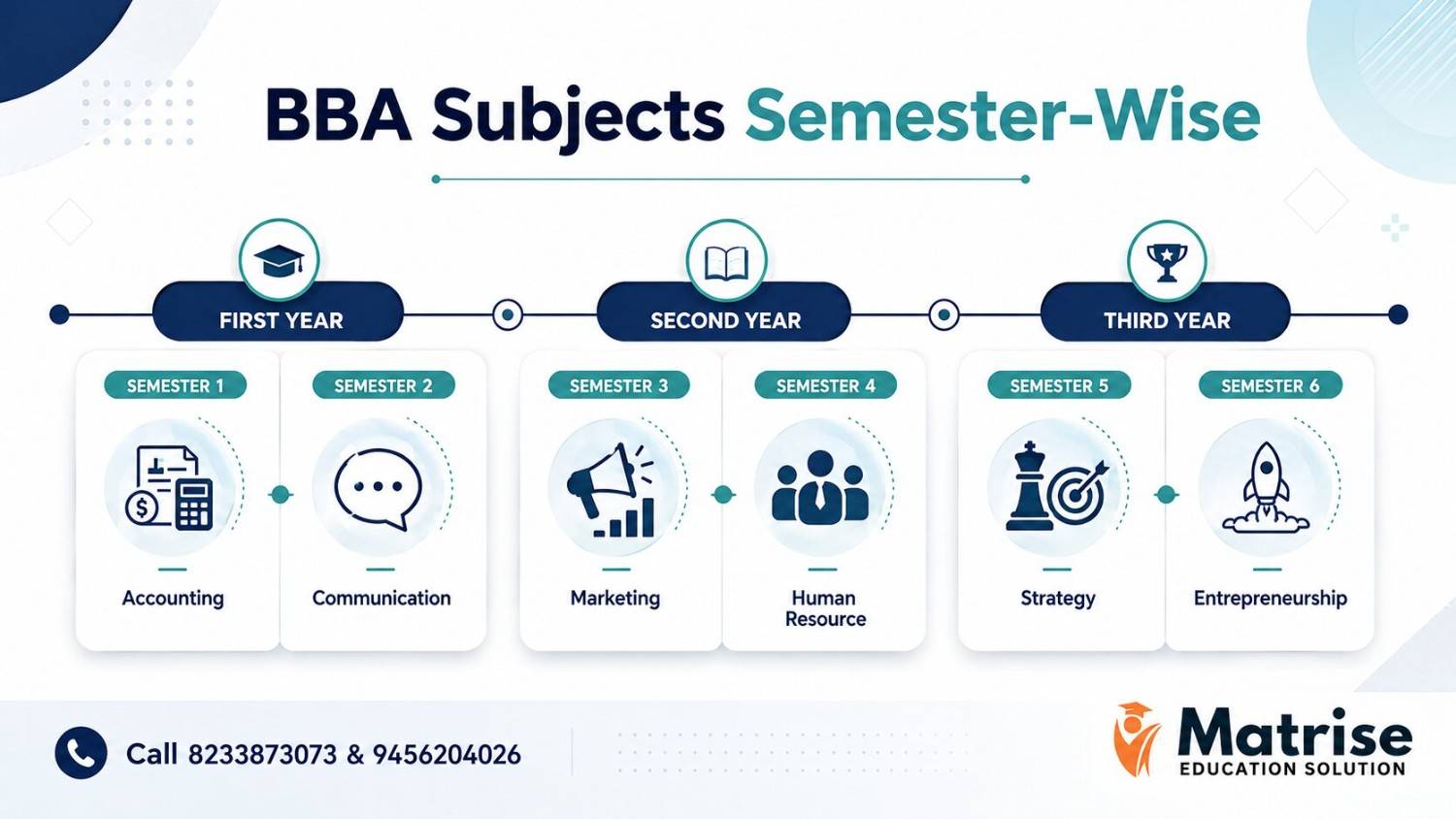
Semester 1 – Foundation Subjects
- Principles of Management: Covers management concepts, classical theories (Taylor, Fayol), and core processes like planning, organising, and controlling.
- Business Communication: Develops written and verbal communication skills essential for professional environments — emails, reports, presentations, and meetings.
- Financial Accounting: Introduces accounting principles, journal entries, ledgers, and financial statement preparation. Builds the base for all future finance subjects.
- Microeconomics and Business Mathematics: Covers individual market dynamics — supply, demand, and price elasticity — alongside quantitative tools like progressions and probability.
- Computer Applications in Business: Teaches essential digital tools including MS Office, spreadsheets, and basic database management used in everyday business operations.
Semester 2 – Building the Business Mindset
- Organisational Behaviour: Studies human behaviour patterns within companies — motivation, leadership, group dynamics, and conflict management.
- Macroeconomics: Explores economy-wide concepts including inflation, unemployment, GDP measurement, and fiscal and monetary policies.
- Marketing Management: Introduces core marketing principles — the 4Ps, market segmentation, positioning, and go-to-market strategies.
- Business Statistics: Covers data collection, measures of central tendency, regression, and correlation — all critical for business decision-making.
- Financial Management Basics: Introduces time value of money, sources of finance, and capital structure concepts.
- Environmental Studies: Addresses sustainability, environmental regulations, and corporate social responsibility — an increasingly important topic for modern businesses.
BBA Year 2 Subjects (Semesters 3 & 4)
The second year moves beyond basics. Students begin applying their knowledge to more complex, real-world business situations. This is where the curriculum starts feeling genuinely practical.
Semester 3 – Intermediate Core Subjects
- Human Resource Management: Covers recruitment, selection, training and development, performance appraisal, and workforce planning.
- Management Accounting: Focuses on cost analysis, budgeting, and variance analysis — tools managers use to make internal financial decisions.
- Operations Management: Examines production planning, capacity management, quality control, and process efficiency in manufacturing and service industries.
- Business Law: Covers contract law, company law, consumer protection regulations, and legal compliance frameworks that every business professional must understand.
- E-Business: Explores digital commerce models — B2B, B2C, D2C — along with e-payment systems and online business strategy.
- Research Methodology: Teaches how to design studies, collect data, and analyse findings — a skill essential for both academic and professional research.
Semester 4 – Applied Business Concepts
- Financial Markets and Institutions: Explains how capital markets, commercial banks, NBFCs, SEBI, and RBI function within India’s financial ecosystem.
- Consumer Behaviour: Studies psychological, social, and cultural factors that influence purchase decisions — vital for anyone entering marketing or sales.
- Corporate Governance and Business Ethics: Covers frameworks for ethical leadership, board accountability, stakeholder management, and ESG compliance.
- Entrepreneurship Development: Introduces business ideation, startup models, feasibility analysis, and venture planning — often tied to the Startup India ecosystem.
- Management Information Systems: Examines how IT infrastructure, ERP systems, and data management tools support business decision-making at every level.
BBA Year 3 Subjects (Semesters 5 & 6)
The third year is where everything comes together. Students tackle strategic subjects, choose their specialisation electives, and gain hands-on industry experience. This is the most career-defining phase of the BBA journey.
Semester 5 – Strategic and Global Perspectives
- Strategic Management: Covers competitive strategy frameworks — Porter’s Five Forces, SWOT, Blue Ocean Strategy — and how organisations formulate and implement long-term plans.
- International Business: Explores cross-border trade, global supply chains, foreign market entry strategies, and the impact of trade policies and currency fluctuations.
- Investment Analysis and Portfolio Management: Introduces financial instruments — equities, bonds, mutual funds — and the principles of risk-return optimisation.
- Supply Chain Management: Covers procurement, warehousing, logistics, and distribution network design across industries.
- Elective Subjects Begin: Students choose from their preferred specialisation track — Finance, Marketing, HR, or Operations — based on their career goals.
Semester 6 – Specialisation and Practical Exposure
- Project Management and Business Policy: Focuses on strategy execution, project lifecycle management, and corporate policy design.
- Elective Subjects (2–4 from chosen stream): Deep-dive into your chosen specialisation with advanced, applied coursework.
- Internship or Live Project Work: A mandatory component of 4–8 weeks. Students work at real companies and apply classroom learning in professional settings.
- Comprehensive Viva-Voce: An oral assessment that tests understanding across all three years of the BBA curriculum.
BBA Specialisation Subjects (Electives)
Electives allow students to tailor their BBA degree to a specific career path. Most universities offer four to six specialisation tracks. Here are the most common ones.
Finance Specialisation
Subjects include Corporate Finance, Financial Derivatives, and International Finance. This track is ideal for students targeting roles in banking, investment analysis, and fintech. Students learn to evaluate financial instruments, manage corporate treasury, and navigate global financial markets.
Marketing Specialisation
Subjects include Sales Management, Digital Marketing, and Brand Management. This track covers both traditional and digital marketing channels — including SEO, social media strategy, and campaign analytics. It prepares students for growth marketing, advertising, and brand management roles.
Human Resource Specialisation
Subjects include Training & Development, Performance Management, and Industrial Relations. This track suits students interested in people management, workplace psychology, and building organisational culture. HR professionals are in demand across every sector.
Operations & Supply Chain Specialisation
Subjects include Total Quality Management, Logistics Management, and Production Planning and Control. This track is highly relevant for careers in manufacturing, e-commerce fulfillment, retail operations, and consulting. It bridges business strategy with operational execution.
Core vs. Elective Subjects: Key Differences
Understanding the difference between core and elective subjects helps you plan your BBA journey smartly.
| Feature | Core Subjects | Elective Subjects |
|---|---|---|
| Mandatory? | Yes — all students study these | No — chosen by student |
| When Studied | Semesters 1–4 primarily | Semesters 5–6 |
| Varies by College? | Minimal variation | Significant variation |
| Career Link | Broad business readiness | Specific role preparation |
| Examples | Financial Accounting, Business Law | Digital Marketing, Financial Derivatives |
A useful tip: always align your elective choices with your target career. For example, if you want to enter growth marketing, the Digital Marketing elective in the Marketing specialisation track is a natural fit. Some universities also allow cross-specialisation electives, giving students a broader skill set across two disciplines.
Practical Components in the BBA Curriculum
BBA is not just a classroom-based degree. Practical learning is built directly into the curriculum at every level.
- Case Study Analysis: Real-world business problem solving is embedded in classroom sessions from Year 1. Students analyse companies like Tata, Infosys, and Zomato.
- Industry Internships: Mandatory practical training, typically in Semester 5 or 6. Students intern at companies relevant to their specialisation.
- Group Projects and Presentations: These simulate boardroom reporting and teamwork, building confidence in communication and collaboration.
- Workshops and Live Business Simulations: Top universities offer market simulation games, entrepreneurship boot camps, and digital marketing labs.
These practical components are what set BBA apart from purely theory-based programs. They are also a major reason why BBA graduates are considered industry-ready from day one.
Career Paths Linked to BBA Subjects
The subjects you study directly shape the roles you can apply for after graduation. Here is how the BBA syllabus maps to real career outcomes.
| Specialisation | Key Roles | Top Sectors |
|---|---|---|
| Finance | Financial Analyst, Account Manager, Financial Advisor | BFSI, Fintech, Consulting |
| Marketing | Marketing Executive, Brand Manager, Digital Marketer | FMCG, E-commerce, Advertising |
| HR | HR Executive, Training Manager, IR Officer | IT, Manufacturing, Consulting |
| Operations | Supply Chain Analyst, Operations Manager | Retail, Logistics, Manufacturing |
Fresh BBA graduates typically start with a salary range of ₹3–6 LPA. This figure rises significantly with experience, higher education, and specialisation depth. You can explore roles on the National Career Service portal to see up-to-date job listings linked to each specialisation.
Many BBA graduates also choose to pursue higher studies. If that is your plan, explore MBA course subjects after BBA to understand what the next level of business education looks like and how BBA subjects directly connect to MBA coursework.
BBA vs. B.Com: Which Subjects Suit You Better?
This is one of the most common questions students ask after Class 12. Both are strong commerce-stream programs, but they serve very different career purposes.
- BBA is management-focused. It covers a wide range of subjects — marketing, HR, strategy, operations, and entrepreneurship. It prioritises practical exposure and leadership training.
- B.Com is accounting and finance-heavy. It goes deeper into taxation, auditing, cost accounting, and financial reporting. It is the better path for students targeting CA, CMA, or ACCA qualifications.
BBA suits students who enjoy communication, problem-solving, and cross-functional thinking. B.Com suits students who are detail-oriented and want to build deep expertise in finance and accounting. To see how B.Com core subjects compare, visit the Matrise B.Com program page for a subject-by-subject breakdown.
| Factor | BBA | B.Com |
|---|---|---|
| Subject Focus | Management, Marketing, Strategy, HR | Accounting, Taxation, Auditing, Finance |
| Industry Alignment | Corporate, E-commerce, FMCG, Startups | Banking, Audit Firms, Government |
| Further Study | MBA, PGDM, Entrepreneurship | M.Com, CA, CMA, CS |
| Practical Exposure | High — internships and live projects | Moderate — theory-heavy |
You can also compare BBA with other commerce programs like MBA and M.Com using Matrise’s comprehensive comparison tool.
Top Universities and Their BBA Syllabus Variations
While the BBA syllabus is broadly standardised, each university adds its own flavour through electives, industry tie-ups, and additional skill modules.
- LPU (Lovely Professional University): Offers strong industry exposure with built-in placement cell support. Focuses heavily on communication and entrepreneurship subjects.
- Amity University: Includes design thinking, behavioural finance, and international exposure programs as part of the BBA curriculum.
- Manipal University: Known for a globally aligned syllabus. Online Manipal also offers a flexible online BBA with similar core subjects.
- Apollo and Manavrachna: Offer UGC-aligned syllabuses with strong regional industry connections for internship placements.
- Mangalayatan University: Focuses on values-based management education alongside standard BBA subjects.
Some institutions are also adding cutting-edge subjects like ESG Reporting and AI for Business to keep the curriculum relevant in 2025 and 2026. When evaluating colleges, always check whether the institution holds UGC-recognized university status. This ensures your degree is accepted by employers and is eligible for postgraduate programs across India.
You can also read about BBA’s global degree structure to understand how Indian BBA programs compare internationally. For those exploring careers in global markets, broader business administration career paths are well documented on Indeed’s career guide.
How Matrise Helps You Navigate BBA Subject Choices
Choosing between universities, specialisations, and elective tracks can feel overwhelming. That is exactly where Matrise steps in.
Matrise is an education consultancy that helps students from across India find the right BBA program based on their academic profile, career goals, and budget. Here is how Matrise supports you:
- Free Career Counselling: Matrise counsellors assess your strengths and match you with the BBA specialisation — Finance, Marketing, HR, or Operations — that fits your goals.
- College Shortlisting: Based on your entrance exam scores and 12th marks, Matrise identifies the right college — government, private, or online — with the best syllabus alignment.
- Admission Guidance: From form filling to document verification and interview preparation, Matrise walks you through every step of the BBA admission process.
- Elective Planning: Matrise counsellors help you plan your Semester 5 and 6 elective choices based on the kind of job role you want to target after graduation.
- Post-BBA Pathway Support: Whether you want to pursue an MBA or enter the workforce directly, Matrise helps you build a roadmap that makes the most of your BBA degree.
Thousands of students have used Matrise to make smarter decisions about their BBA admission. The right guidance at the right time can completely change your career trajectory.
Frequently Asked Questions About BBA Course Subjects
What are the main subjects in a BBA course?
The main BBA subjects include Principles of Management, Financial Accounting, Business Communication, Marketing Management, Human Resource Management, Business Law, Organisational Behaviour, and Strategic Management. These core subjects are studied across the first four semesters. Specialisation electives are added in Semesters 5 and 6.
Which BBA subjects are studied in the first year?
In the first year, students study Principles of Management, Business Communication, Financial Accounting, Microeconomics, Business Mathematics, Computer Applications in Business, Organisational Behaviour, Macroeconomics, Marketing Management, Business Statistics, and Environmental Studies. These are foundational subjects that prepare students for more advanced topics in Year 2 and Year 3.
Is BBA available after completing any stream in Class 12?
Yes. BBA is open to students from Science, Commerce, and Arts streams. You simply need to have completed 10+2 from a recognised board with at least 50% marks in most universities. Some colleges may have specific requirements, so it is always best to check the official admission criteria before applying.
What is the difference between BBA core subjects and elective subjects?
Core subjects are mandatory for all BBA students regardless of the university. They cover foundational business topics like accounting, law, marketing, and management. Elective subjects are chosen by students in the final year and are aligned with a specific specialisation — such as Finance, Marketing, HR, or Operations. Electives vary between universities and allow students to customise their degree toward their career goals.
What career options are available after completing a BBA?
BBA graduates can pursue roles such as Financial Analyst, Marketing Executive, HR Executive, Brand Manager, Operations Analyst, Business Development Associate, and more. Starting salaries typically range from ₹3 to ₹6 LPA. With an MBA or relevant certifications, earnings rise significantly. Top hiring sectors include BFSI, FMCG, e-commerce, IT companies, and business consultancies.
Is BBA better than B.Com for a management career?
BBA is generally better suited for a management career because it covers a broader range of business subjects — including marketing, HR, strategy, and operations — alongside practical exposure through internships. B.Com is better suited for students who want to go deeper into accounting and finance, or pursue professional qualifications like CA or CMA. Your choice should depend on your career goals rather than the program’s general reputation.
Does the BBA syllabus change from college to college?
The core BBA subjects remain largely consistent across UGC-recognised universities. However, elective offerings, practical components, and additional skill modules can vary significantly. Top universities like Amity, Manipal, and LPU often include cutting-edge subjects like Digital Marketing, ESG Reporting, or Behavioural Finance that smaller colleges may not offer. Always review the official syllabus before finalising your college choice.
Conclusion: Make Your BBA Subject Choice Count
The BBA curriculum is one of the most comprehensive undergraduate programs available in India today. It gives students a broad foundation in business and management during the first two years, then allows meaningful specialisation in the third year. Whether your interest lies in finance, marketing, HR, or operations, the BBA syllabus is designed to prepare you for a dynamic career in the corporate world.
Understanding BBA course subjects is the first step. The next step is choosing the right college, the right specialisation, and the right support system for your journey.
That is where Matrise comes in. From free career counselling to end-to-end admission support, Matrise helps students across India make confident, informed decisions about their BBA education. Do not leave your career to chance. Visit the complete BBA eligibility, fees & top colleges page on Matrise today and take the first step toward your business career.