

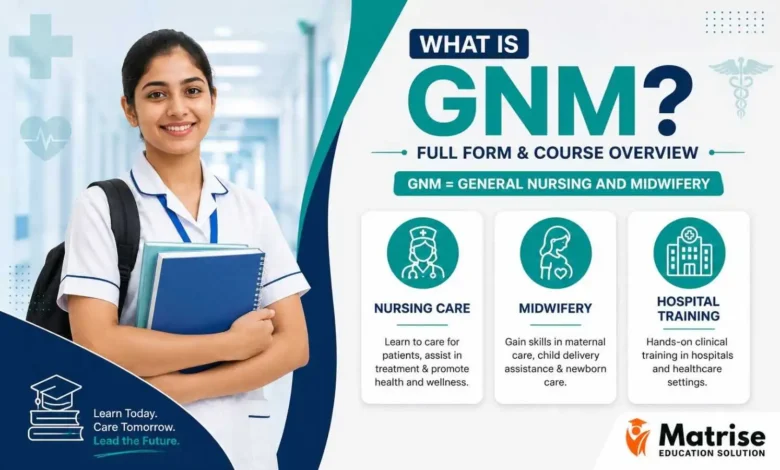
GNM Course Details help students understand the General Nursing and Midwifery diploma after Class 12. GNM is a practical nursing course that trains students in patient care, hospital duties, community health, and maternal care. It is suitable for students who want a direct route into nursing careers.
The GNM nursing course is popular among students who want job-focused healthcare training after 12th. It covers theory, lab practice, hospital posting, and clinical exposure. Students often compare GNM with ANM and B.Sc Nursing before applying. Matrise helps students understand eligibility, fees, admission steps, colleges, and career options with clear GNM nursing admission guidance.

What Is GNM Course?
GNM stands for General Nursing and Midwifery. It is a diploma-level nursing course focused on patient care, clinical nursing, community health, and midwifery. The course prepares students to work in hospitals, clinics, nursing homes, community health centres, and other healthcare settings.
GNM is different from a degree course like B.Sc Nursing. It focuses more on practical nursing training and hospital-based learning. Students learn how to support doctors, care for patients, maintain records, assist in treatment, and handle basic nursing responsibilities.
- It is a diploma course in nursing.
- It is commonly chosen after Class 12.
- It includes classroom and clinical training.
- It covers general nursing and maternal care.
- It can lead to hospital, community, and home healthcare jobs.
GNM Course Full Form and Basic Meaning
The full form of GNM is General Nursing and Midwifery. General nursing covers patient care, medicines, ward duties, hygiene, health education, and basic hospital support. Midwifery focuses on maternal care, pregnancy support, childbirth assistance, and newborn care.
In simple words, GNM trains students to become skilled nursing professionals. They learn how to care for patients in real healthcare environments. They also learn how to support mothers and newborns during important stages of care.
Who Should Choose GNM?
GNM is suitable for students who are interested in healthcare, patient support, and hospital work. It can be a good choice for those who want to enter nursing through a diploma route after Class 12.
- Students who want practical clinical training.
- Students who are comfortable helping patients directly.
- Students who can handle responsibility and discipline.
- Students who want a nursing career after 12th.
- Students who prefer hands-on learning over only classroom study.
GNM is best for students who can manage long working hours, emotional situations, and direct patient interaction. Nursing needs patience, alertness, and a service mindset.
GNM Course Highlights at a Glance
Before applying, students should understand the basic GNM course details. The exact rules may differ by state, college, and nursing council guidelines. Still, the table below gives a quick overview.
| Course Detail | Information |
|---|---|
| Course Name | General Nursing and Midwifery |
| Course Type | Diploma in nursing |
| Common Duration | Usually 3 years plus internship or clinical training, depending on rules |
| Minimum Qualification | 10+2 with English and required minimum marks |
| Preferred Stream | Science is often preferred, but rules may allow other streams |
| Admission Mode | Merit, entrance exam, or state counselling |
| Career Options | Staff nurse, ward nurse, community health nurse, home care nurse |
Key Details to Include in the Course Snapshot
The course name is General Nursing and Midwifery. The course type is a diploma in nursing. The duration is commonly structured as 3 years plus internship or clinical training, depending on current institutional and state rules.
Main career paths include staff nurse, community health nurse, ward nurse, home care nurse, maternity care nurse, and further studies. Students should also compare nursing admission options after 12th before selecting a final course.
GNM Course Duration and Training Structure
The GNM course duration usually includes classroom learning, laboratory practice, hospital posting, and internship or clinical exposure. Students learn nursing theory and then apply it under supervision in real healthcare settings.
This structure helps students build confidence before entering full-time nursing jobs. A student may attend lectures in the morning and complete ward postings or lab sessions later in the day.
Year-Wise Learning Flow
- First year: Students learn the foundation of nursing, anatomy, physiology, microbiology, and basic patient care.
- Second year: Students study medical-surgical nursing, mental health nursing, child health nursing, and hospital procedures.
- Third year: Students focus on community health nursing, midwifery, gynecological nursing, and advanced clinical duties.
The year-wise flow gives students steady growth. They start with basic concepts and later handle more complex patient care tasks.
Internship and Clinical Posting
Clinical posting means practical training in hospitals or healthcare centres. It is one of the most important parts of the GNM nursing course. Students observe, assist, and learn under trained professionals.
Clinical exposure may include medical wards, surgical wards, pediatric wards, maternity wards, emergency units, and community health centres. Students should check whether the college has a recognized parent hospital or strong clinical tie-ups.
GNM Eligibility Criteria After 12th
GNM course eligibility usually requires students to pass 10+2 from a recognized board. English is generally required as a subject. The Indian Nursing Council GNM eligibility criteria mention 10+2 with English and minimum qualifying marks, with science preferred.
Eligibility can vary slightly by state, institution, and admission authority. Therefore, students should always verify the latest official admission notice before applying.
Educational Qualification Required
Students should have passed Class 12 from a recognized board. English is usually required. Science students are often preferred, but some rules may allow Arts or Commerce students if they meet the required conditions.
NIOS or state open school eligibility may apply where recognized by the admission authority. Students should check this carefully before filling out the GNM course application form.
Minimum Marks and Age Limit
The common minimum marks requirement is often around 40% in Class 12, subject to current rules. Some colleges may ask for higher marks because of competition. Age limits may also apply and are usually checked according to admission-year rules.
Students should verify the latest state nursing council or college admission notice before applying. Matrise can help students understand changing admission requirements and avoid confusion during form filling.
GNM Admission Process
The GNM admission process may be merit-based, entrance-based, or counselling-based. It depends on the state and institution. Some colleges select students through Class 12 marks. Others follow state-level counselling or entrance tests.
Before applying, students should confirm whether the college is recognized. They can also review INC-recognised nursing institutes to understand official recognition better.
Merit-Based Admission
In merit-based admission, colleges select students based on Class 12 marks. The college may prepare a merit list and call shortlisted students for counselling or document verification.
For example, a college may calculate merit using 10+2 marks. Then it may invite eligible students to complete admission, pay fees, and submit documents.
Entrance Exam or State Counseling
Some states or institutions may conduct a GNM nursing entrance exam. Others may use centralized counselling. The common stages include application form, admit card, exam or merit list, counselling, seat allotment, and fee payment.
Students should track official state nursing admission portals. They should not rely only on private college advertisements. Matrise helps students follow the right steps for GNM nursing admission 2026.
Documents Usually Required
- Class 10 marksheet and certificate.
- Class 12 marksheet and certificate.
- Transfer certificate.
- Migration certificate, if required.
- Caste or category certificate, if applicable.
- Government ID proof.
- Passport-size photographs.
- Medical fitness certificate.
- Admission authority documents, if required.
GNM Syllabus and Subjects
The GNM syllabus gives students a strong base in nursing, health science, community care, and midwifery. Syllabus details may follow INC or state nursing council guidelines. Students can refer to the revised GNM syllabus for official syllabus-related updates.
The GNM subjects can be divided into foundation subjects, clinical subjects, community health subjects, and midwifery-related areas.
First-Year GNM Subjects
- Anatomy and physiology.
- Fundamentals of nursing.
- Microbiology and hygiene.
- Psychology and sociology.
- Basic community health concepts.
Students learn how to check vital signs, maintain patient hygiene, and understand body systems. This year builds the foundation for hospital training.
Second-Year GNM Subjects
- Medical-surgical nursing.
- Pharmacology basics.
- Psychiatric or mental health nursing.
- Child health nursing.
- Practical hospital exposure.
Students may assist in patient monitoring, wound care, medication support, and pediatric care. They also learn how to support patients with different health conditions.
Third-Year GNM Subjects
- Midwifery and gynecological nursing.
- Community health nursing.
- Nursing administration basics.
- Ward management basics.
- Advanced clinical practice and field visits.
Students interested in maternal and child health should pay special attention to midwifery training. This area plays an important role in maternity and newborn care.
Skills Students Learn During GNM
GNM is not only about academic subjects. It also develops practical nursing skills, emotional strength, and communication ability. These skills grow through lab practice, hospital postings, and patient interaction.
Clinical and Patient Care Skills
- Checking temperature, pulse, respiration, and blood pressure.
- Assisting doctors and senior nurses during treatment.
- Maintaining patient hygiene.
- Supporting wound dressing and medication routines.
- Maintaining patient records.
For example, a GNM student may learn how to prepare a patient for surgery or monitor recovery after an operation.
Communication and Emergency Response Skills
Nurses communicate with patients, families, doctors, and hospital staff. They often act as the link between patients and doctors. Good communication helps reduce fear and improves patient care.
Students also learn how to stay calm during stressful situations. Basic emergency care and first-response support are important parts of nursing training.
GNM Course Fees
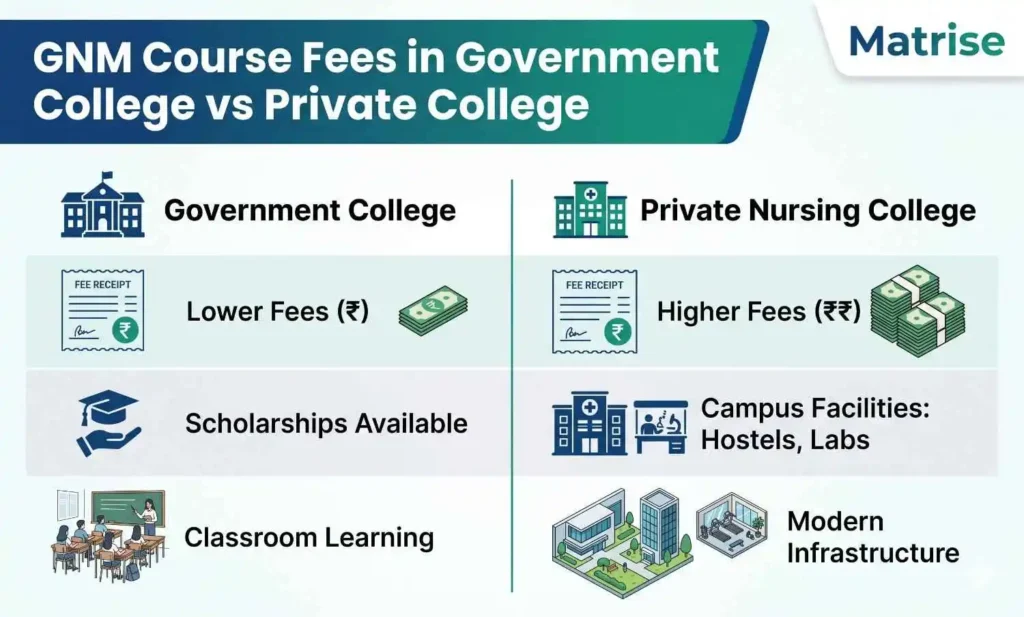
GNM course fees vary by college type, location, hostel facility, hospital tie-up, and training quality. Government colleges usually have lower fees. Private colleges may charge more because of infrastructure, hostel, and clinical arrangements.
Students should compare total cost, not only tuition fees. They can also review GNM nursing course fees before planning admission.
Government College Fees vs Private College Fees
Government colleges usually have lower fees but higher competition. Private colleges may offer more seats, but their fees can be higher. Some private colleges may also add charges for hostel, transport, exam, lab, and clinical training.
Students should ask for a written fee structure before taking admission. This prevents confusion later.
Other Expenses to Consider
- Uniforms and shoes.
- Books and notebooks.
- Nursing kit and lab charges.
- Hostel and mess fees.
- Transport for clinical postings.
- Exam and registration charges.
A low tuition fee may still become expensive if hostel and clinical transport costs are high. Therefore, students should calculate the full yearly cost.
How to Choose the Right GNM College
Choosing the right GNM nursing college is very important. A poor-quality or unrecognized institution can create problems during registration and job search. Students should check recognition, clinical exposure, faculty, and student support.
Recognition and Approval
Students should check whether the college is recognized by the proper nursing council. They should verify state nursing council approval and institutional permission. They should avoid colleges that cannot clearly show recognition or approval.
Do not rely only on brochures. Official lists and admission notices are more reliable.
Hospital Training Facilities
Good clinical exposure is essential in nursing. Students should look for colleges with strong hospital posting arrangements. They should ask about patient load, lab facilities, parent hospital, internship structure, and department exposure.
A college attached to a working hospital may offer better hands-on learning than one with weak clinical tie-ups.
Placement and Student Support
Students should check placement assistance, alumni feedback, pass percentage, hostel safety, library, labs, and mentorship. They should also ask whether the college supports nursing registration after course completion.
Matrise helps students compare colleges, admission steps, and course options so they can make a safer decision.
Career Options After GNM
GNM career scope includes hospitals, clinics, public health programmes, home healthcare, schools, NGOs, and further studies. Students must complete registration requirements before working as nurses.
Job Roles After GNM
- Staff nurse in hospitals and nursing homes.
- Community health nurse.
- Home healthcare nurse.
- Ward nurse.
- Emergency care assistant.
- Maternity care nurse.
A GNM graduate may start as a junior staff nurse. Later, they can move into ICU, OT, maternity, emergency, or community health roles with experience and training.
Workplaces That Hire GNM Graduates
GNM graduates may work in private hospitals, multispecialty hospitals, government health centres, clinics, nursing homes, NGOs, schools, and home care agencies. Government roles may require exams, nursing registration, and state-specific eligibility.
Students can also explore healthcare job opportunities through government-managed career resources. Public health roles may also connect with the Community Health Officer pathway.
Salary Scope After GNM
GNM salary depends on location, hospital type, experience, department, and shift duties. Freshers usually start with lower salaries and grow with experience, specialization, and further education.
Fresher Salary Expectations
Freshers may start in private hospitals, clinics, nursing homes, or home healthcare settings. Metro cities may offer different pay than smaller towns. Salary may also change based on night shifts, overtime, department type, and hospital reputation.
Students should evaluate learning exposure along with salary in their first job. A role with strong training can support better long-term growth.
Salary Growth With Experience
Experienced nurses may grow into senior staff nurse, ward in-charge, supervisor, or specialized department roles. Additional certifications in ICU, emergency care, operation theatre, dialysis, neonatal care, or geriatric care can improve opportunities.
Further studies can also improve long-term career growth and academic options.
Higher Studies After GNM
GNM graduates can continue their education after completing the diploma. Higher studies can improve career scope, academic value, and leadership opportunities.
Post Basic B.Sc Nursing After GNM
Many GNM graduates choose Post Basic B.Sc Nursing after GNM to upgrade their qualification. Eligibility usually requires GNM completion and nursing registration.
This path can improve academic standing, career options, and scope for teaching or advanced roles. It is a common choice for students who want to grow beyond entry-level nursing jobs.
Short-Term Specialization Courses
- ICU nursing.
- Emergency nursing.
- Operation theatre nursing.
- Dialysis nursing.
- Neonatal care.
- Geriatric care.
Students should choose certifications from recognized institutions with real clinical exposure. Practical training matters more than only a certificate.
GNM vs ANM vs B.Sc Nursing
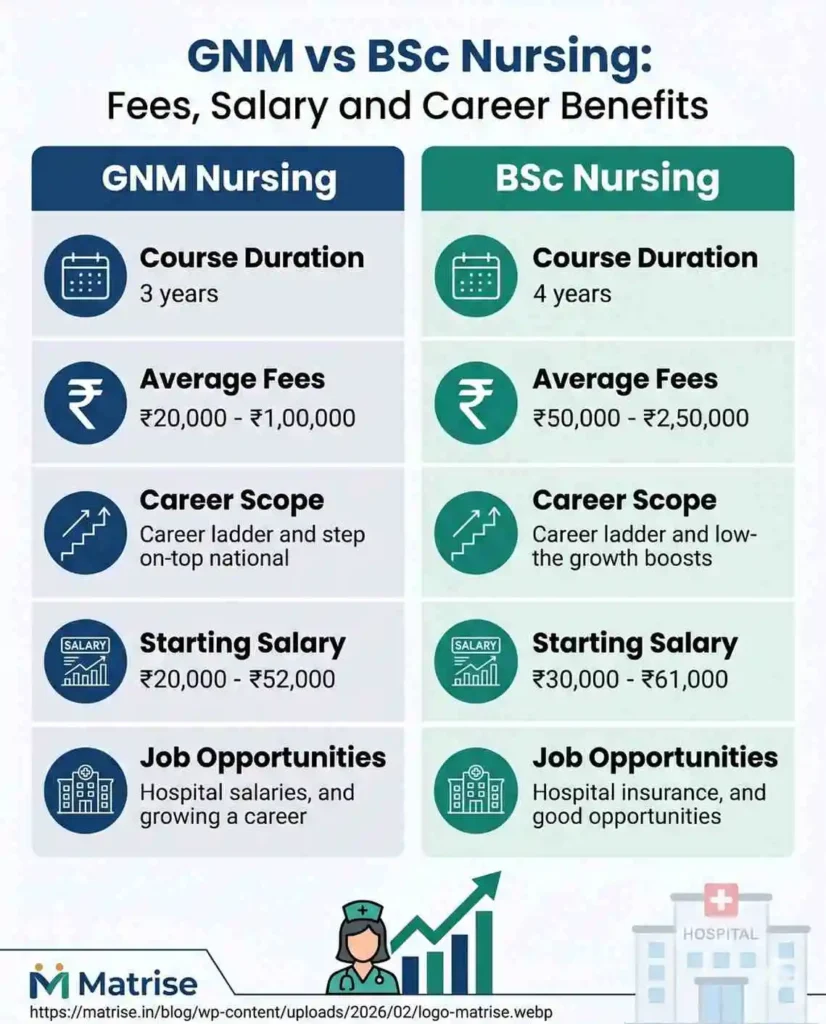
Students often compare GNM with ANM and B.Sc Nursing before choosing a nursing course after 12th. ANM is shorter and more community-health focused. GNM is a diploma with broader nursing training. B.Sc Nursing is a degree course with wider academic scope.
| Course | Level | Focus Area | Best For |
|---|---|---|---|
| ANM | Diploma | Basic nursing, maternal care, community health | Students who want a shorter community-health route |
| GNM | Diploma | Hospital nursing, patient care, midwifery, community health | Students who want practical nursing training after 12th |
| B.Sc Nursing | Degree | Advanced nursing theory, clinical practice, research basics | Students who want a degree and stronger academic scope |
Difference Between GNM and ANM
ANM generally focuses more on basic nursing, maternal care, and community health. GNM offers broader hospital-based nursing and midwifery training. GNM may offer wider clinical job options than ANM.
A student aiming for staff nurse roles in hospitals may prefer GNM over the ANM nursing course, especially in duration, scope, and career direction.
Difference Between GNM and B.Sc Nursing
GNM is a diploma course, while B.Sc Nursing is a degree course. B.Sc Nursing may offer stronger academic and long-term career scope. However, GNM can be a faster diploma route for students who want practical nursing training.
Students with strong academic goals and budget flexibility should compare GNM with the B.Sc Nursing course before choosing. They can also read Gnm Nursing Course 2026 Full Form Duration Eligibility Fees Admission for a deeper course overview.
Is GNM a Good Career Option?
GNM can be a good career option for students who want to enter healthcare after Class 12. Nursing has steady demand, but the work can be physically and emotionally demanding. Students should choose it only after understanding both benefits and challenges.
Advantages of Choosing GNM
- Entry into the healthcare sector after Class 12.
- Practical and job-oriented training.
- Opportunities in hospitals, clinics, community health, and home care.
- Scope for further studies like Post Basic B.Sc Nursing.
- Strong patient-care learning through clinical exposure.
Challenges Students Should Know
- Long shifts and night duties.
- Emergency work and stressful situations.
- Emotional pressure while caring for seriously ill patients.
- Need for discipline, patience, and continuous learning.
Students should visit a hospital or speak with working nurses before choosing the course. This gives a real idea of nursing life.
FAQ
What is GNM course?
What is the full form of GNM?
What is the duration of GNM course?
What is the eligibility for GNM course?
Can I do GNM after 12th?
Can Arts students apply for GNM course?
Can Commerce students apply for GNM nursing?
What is the minimum percentage required for GNM admission?
What is the age limit for GNM course?
What is the admission process for GNM course?
Is there any entrance exam for GNM nursing?
What are the subjects in GNM course?
What is the syllabus of GNM nursing?
What is the fee for GNM course?
What is the difference between GNM and ANM?
Conclusion
GNM Course Details are important for every student planning a nursing career after 12th. The course offers practical training in patient care, clinical nursing, community health, and midwifery. It can lead to jobs in hospitals, clinics, public health, and home healthcare.
However, students should choose the course carefully. They must check eligibility, fees, recognition, clinical exposure, and career goals before applying. Matrise makes this process easier by guiding students through GNM eligibility, admission, college selection, fees, and future study options.
For clear nursing admission support, connect with Matrise and take the next step toward a confident healthcare career.