
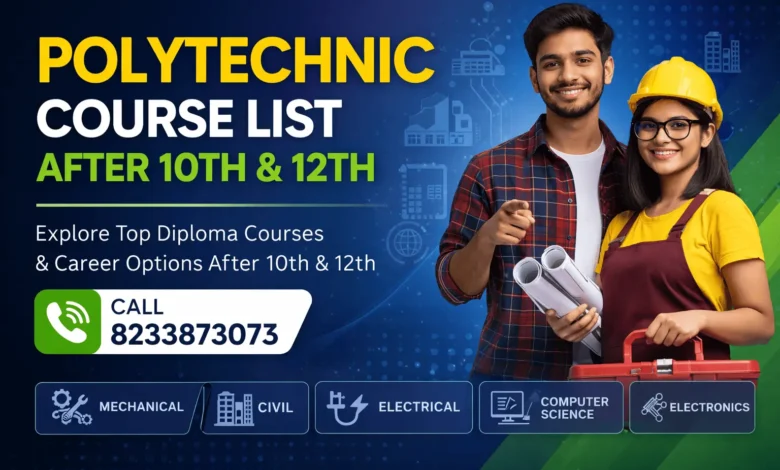
A polytechnic course is a government-recognized technical diploma program that students can pursue after 10th or 12th class. It typically lasts 3 years and covers engineering and vocational fields like Civil, Mechanical, Computer Science, and Electrical Engineering. Polytechnic is the fastest route to a technical career — with lower fees, earlier job entry, and a direct pathway to B.Tech through lateral admission.
What is a Polytechnic Course? Complete Overview
A polytechnic course is a technical diploma program offered by government and private polytechnic institutes across India. It is designed to give students hands-on, practical education in engineering and technical fields so they can enter the workforce faster than traditional degree routes.
The word “polytechnic” comes from the Greek poly (many) + technē (arts/skills). True to its name, polytechnic institutes teach multiple technical disciplines — from civil construction and automobile engineering to computer programming and fashion technology.
These courses are regulated by the respective state’s Board of Technical Education (SBTE) and are recognized by the All India Council for Technical Education (AICTE). If you are looking for a structured path to explore diploma courses and admissions, Matrise offers complete guidance for students at every stage.
Polytechnic Course Kya Hota Hai? (What Is It, Simply Explained)
Simply put — polytechnic ek aisa 3 saal ka diploma program hai jisme 10th ke baad admission milta hai. Isme theory ke saath-saath practical training bhi diya jata hai taaki student seedha job ke liye ready ho sake.
Not Sure Which Course to Choose After 10th?
Get personalized course advice from Matrise experts — completely free. We’ll help you pick the right polytechnic stream based on your interest and career goals.
Polytechnic Course After 10th — Everything You Need to Know
Polytechnic after 10th is the most common entry point. Students who have passed their Class 10 board exam are eligible to apply for a 3-year diploma program. This is an excellent choice for students who want to skip the 2-year 11th–12th cycle and enter technical education directly.
Polytechnic Course After 10th — Eligibility
- Must have passed Class 10th from a recognized board (CBSE, UP Board, ICSE, or State Board)
- Minimum 35%–50% marks (varies by state and institute)
- Age: Usually 14 years and above
- No age bar in most states for government polytechnic admission
Polytechnic Course Duration
The standard polytechnic course duration is 3 years (6 semesters) for students entering after 10th class. Some diploma courses are of 2 years duration, especially lateral entry or vocational programs.
Polytechnic Courses List After 10th
Here is a comprehensive list of the most popular polytechnic courses available after 10th class:
| Course Name | Duration | Industry Sector |
|---|---|---|
| Civil Engineering | 3 Years | Construction, Infrastructure |
| Mechanical Engineering | 3 Years | Manufacturing, Automobile |
| Computer Science & Engineering (CSE) | 3 Years | IT, Software |
| Electrical Engineering | 3 Years | Power, Energy |
| Electronics & Communication (ECE) | 3 Years | Telecom, Electronics |
| Information Technology (IT) | 3 Years | IT, Networking |
| Chemical Engineering | 3 Years | Pharma, Chemicals |
| Automobile Engineering | 3 Years | Auto Industry |
| Architecture Assistantship | 3 Years | Construction, Design |
| Fashion Designing | 3 Years | Apparel, Textile |
| Food Technology | 3 Years | FMCG, Food Processing |
| Environmental Engineering | 3 Years | Environmental Services |
Polytechnic Course After 12th — Is It Worth It?
Yes, pursuing a polytechnic course after 12th is still a smart choice — especially for students who couldn’t secure admission in a top B.Tech college or want to enter the workforce quickly. Students who join polytechnic after 12th with PCM (Physics, Chemistry, Maths) can often get advanced placement or complete the diploma in 2 years (lateral entry provisions vary by state).
Benefits of Polytechnic After 12th
- Lower course fees compared to B.Tech programs
- Job-ready in 2–3 years
- Can pursue B.Tech lateral entry (2nd year) after diploma
- Good option if B.Tech entrance exam was not cleared
- Practical, industry-relevant curriculum
After polytechnic, students can explore top B.Tech options. You can read more about which B.Tech course is best for the future to plan your career path wisely.
Top Polytechnic Courses — Which Course Is Best?
Choosing the best polytechnic course depends on your interest, location, and career goal. However, based on placement records, salary packages, and industry demand, here are the top-ranked courses:
| Rank | Course | Starting Salary (₹/Year) | Top Recruiters |
|---|---|---|---|
| 🥇 1 | Computer Science & Engineering | ₹2.4L – ₹6L | TCS, Infosys, Wipro, HCL |
| 🥈 2 | Civil Engineering | ₹1.8L – ₹4.5L | L&T, NHAI, PWD, CPWD |
| 🥉 3 | Mechanical Engineering | ₹1.8L – ₹4L | BHEL, DRDO, Maruti, HAL |
| 4 | Electrical Engineering | ₹1.8L – ₹4L | NTPC, BSES, UPPCL, Siemens |
| 5 | Electronics & Communication | ₹2L – ₹4.5L | BSNL, Airtel, Samsung, BEL |
For a detailed analysis of the best future-oriented technical courses, this detailed guide on future-ready courses is a great read for students making their career decisions.
Polytechnic Course Fees — Government vs Private
One of the biggest advantages of polytechnic courses is the affordable fee structure, especially in government institutions. Here’s a comparison:
| Type of Institute | Annual Fees (Approx.) | Total 3-Year Cost |
|---|---|---|
| Government Polytechnic | ₹5,000 – ₹20,000 | ₹15,000 – ₹60,000 |
| Private Polytechnic (Aided) | ₹15,000 – ₹35,000 | ₹45,000 – ₹1,05,000 |
| Private Polytechnic (Unaided) | ₹25,000 – ₹80,000 | ₹75,000 – ₹2,40,000 |
Polytechnic Course Subjects — Semester-wise Structure
Polytechnic courses are divided into 6 semesters. Each semester covers a mix of theory subjects and practical lab work. Here’s a general subject structure for Computer Science (as an example):
- Semester 1–2: Engineering Mathematics, Communication Skills, Physics, Chemistry, Basic Computer Applications, Workshop Practice
- Semester 3–4: Data Structures, Object-Oriented Programming (OOP), Database Management System (DBMS), Operating Systems, Web Technology
- Semester 5–6: Computer Networks, Software Engineering, Cyber Security, Project Work, Industrial Training (Internship)
All polytechnic courses include mandatory industrial training in the final semester, which significantly improves placement prospects — a major reason polytechnic diploma holders are preferred by many companies.
After Polytechnic — Which Course is Best?
Completing a polytechnic diploma opens multiple career paths. Here’s a clear roadmap for what to do after polytechnic:
B.Tech via Lateral Entry (Most Recommended) — Get direct admission to the 2nd year of B.Tech. This saves 1 year and reduces overall B.Tech cost significantly. Check all details about B.Tech admissions at Matrise.
Direct Employment — Many companies hire diploma holders for roles like Junior Engineer, Site Supervisor, Technician, Field Engineer, and more. Government PSUs like NTPC, BHEL, and DRDO conduct dedicated recruitment for diploma engineers.
AMIE (Associate Member of Institution of Engineers) — An exam-based route to get an engineering degree equivalent, recognized by UPSC and many employers.
Advanced Diploma / PG Diploma — Pursue specialized diploma courses in areas like Cyber Security, AutoCAD, PLC & SCADA, or Digital Marketing to enhance your skill set.
Government Jobs — Apply for ITI instructor posts, JE (Junior Engineer) in government departments, or technical assistant positions in railways and defense sectors.
If you’re planning to pursue B.Tech after polytechnic, make sure to check the latest B.Tech admission 2026 guide to know important dates, eligibility, and application procedures.
Polytechnic Entrance Exam — How to Get Admission
Admission to most government polytechnic colleges is through a state-level entrance exam. Here’s a step-by-step guide to the admission process:
Fill Online Application Form — Visit your state’s polytechnic admission portal. Common portals: Jeecup.admissions.nic.in (UP), Sbte.jharkhand.gov.in, etc.
Appear in the Entrance Exam — Most states conduct polytechnic entrance exams covering Mathematics, Science (Physics & Chemistry), and General Intelligence. Some states also offer merit-based direct admission.
Check Result & Rank — After the entrance exam, check your polytechnic diploma result and merit rank on the official website.
Counselling & Seat Allotment — Participate in online counselling and select your preferred college and branch. Documents required: 10th marksheet, domicile certificate, caste certificate (if applicable), passport photo.
Polytechnic Class Start Date — Classes generally begin in August–September after the admission process. For 2025 batches, classes typically started in August 2025. Always verify the polytechnic class start date 2025 from your college’s official notice board.
Diploma Courses With Placement — Why Polytechnic Stands Out
One major concern for students is job placement after a diploma. The good news: polytechnic courses have excellent placement records, especially in engineering streams. Here’s why:
- Industry-linked curriculum — AICTE regularly updates the syllabus in collaboration with industry leaders
- Mandatory internship/training — Every student must complete industrial training, giving them real-world experience
- Campus placement drives — Many polytechnic colleges have dedicated Training & Placement cells that invite companies for recruitment
- Government jobs eligibility — Diploma holders are eligible for Junior Engineer (JE), Technical Assistant, and other government posts
- Apprenticeship opportunities — Under the National Apprenticeship Promotion Scheme (NAPS), diploma holders can earn while they learn
How Matrise Helps You With Polytechnic & Beyond
Choosing the right course, college, and career path is overwhelming — and that’s exactly where Matrise comes in. Matrise is an education platform that provides end-to-end guidance for students from admission to career planning.
- 📋 Course Selection Support — Compare polytechnic streams based on your aptitude and market demand
- 🏫 College Shortlisting — Get a curated list of top polytechnic colleges near you with fee structures and placement data
- 📝 Admission Form Assistance — Step-by-step help filling entrance exam forms and counselling applications
- 🎓 Post-Diploma Guidance — Plan your B.Tech lateral entry, competitive exams, or job application strategy
- 💬 WhatsApp Counselling — Instant access to education experts for personalized advice
Whether you’re exploring a diploma course right after 10th, or planning to upgrade to a full B.Tech degree, Matrise has resources and expert support at every step of your journey.
The best polytechnic course depends on your interest. However, Computer Science & Engineering (CSE) is currently ranked #1 due to high demand, top placements, and salary packages. Other top choices include Civil Engineering (infrastructure boom), Mechanical Engineering (manufacturing sector), and Electrical Engineering (energy sector). Choose based on your strengths — if you enjoy computers and coding, go for CSE; if you prefer site work and construction, Civil Engineering is excellent.
The top 3 polytechnic courses based on placement and demand in 2025–26 are: 1) Computer Science & Engineering (CSE) — highest IT sector placements; 2) Civil Engineering — evergreen demand with government and private sector jobs; 3) Mechanical Engineering — wide scope across automobile, manufacturing, and PSU sectors. Each of these fields offers clear career growth paths and B.Tech lateral entry options.
A 3-year diploma course (polytechnic) is a technical education program that runs for 6 semesters after Class 10. It provides both theoretical knowledge and practical training in an engineering or vocational discipline. Upon completion, students receive a government-recognized diploma certificate from their state’s Board of Technical Education (SBTE), making them eligible for jobs, government exams, and B.Tech lateral entry.
3 साल का डिप्लोमा कोर्स (पॉलिटेक्निक) एक तकनीकी शिक्षा कार्यक्रम है जो 10वीं के बाद 6 सेमेस्टर में पूरा होता है। इसमें इंजीनियरिंग या वोकेशनल फील्ड में थ्योरी और प्रैक्टिकल ट्रेनिंग दोनों शामिल होती हैं। कोर्स पूरा होने पर राज्य तकनीकी शिक्षा बोर्ड (SBTE) से मान्यता प्राप्त डिप्लोमा सर्टिफिकेट मिलता है। इससे नौकरी, सरकारी परीक्षाएं और B.Tech लेटरल एंट्री के दरवाजे खुलते हैं।
पॉलिटेक्निक में 50 से अधिक कोर्स उपलब्ध हैं। प्रमुख कोर्सेज में Civil Engineering, Mechanical Engineering, Electrical Engineering, Computer Science & Engineering, Electronics & Communication, IT, Chemical Engineering, Automobile Engineering, Architecture Assistantship, Fashion Designing, Food Technology शामिल हैं। प्रत्येक राज्य में अलग-अलग कोर्स उपलब्ध होते हैं — अपने राज्य के polytechnic admission portal पर पूरी list देख सकते हैं।
Yes! After completing a polytechnic diploma, you can pursue B.Tech through Lateral Entry — meaning direct admission to the 2nd year of B.Tech. This path saves 1 year and significantly reduces your total education cost. Most state technical universities accept diploma holders for lateral entry. Matrise provides full support for B.Tech lateral entry admissions — from college selection to application help.
In government polytechnic colleges, the annual fee ranges from approximately ₹5,000 to ₹20,000 per year, making the total 3-year cost between ₹15,000 and ₹60,000. Private polytechnic colleges charge ₹25,000 to ₹80,000 per year. SC/ST/OBC students may qualify for state government fee waivers and scholarships, reducing the cost to almost nil in government colleges.
Ready to Start Your Polytechnic Journey?
Join thousands of students who found their right course with Matrise. Get free counselling, college comparisons, and step-by-step admission help — right on WhatsApp.