


BBA course subjects list 1st year typically includes 10 to 12 subjects spread across two semesters. Semester 1 covers Principles of Management, Financial Accounting, Business Communication, Microeconomics, and Business Mathematics. Semester 2 includes Macroeconomics, Business Law, Computer Applications, Organizational Behavior, and Environmental Studies. These subjects build a strong foundation for a successful business career.
If you are a 12th pass student planning BBA admission, or a current BBA first year student looking for subject clarity, this guide is for you. Understanding the BBA 1st year subjects early helps you plan your studies better. It also removes confusion about what you will actually learn in the classroom. Many students search for the BBA first year syllabus but find scattered, incomplete information. That is why Matrise has created this detailed, semester-wise breakdown. Here, you will find every subject explained simply. You will also discover difficulty levels, study tips, university comparisons, and recommended books. Whether you come from a Commerce, Science, or Arts background, this article covers everything. For a complete overview across all three years, check the BBA course subjects complete syllabus on Matrise.
BBA Course Subjects List 1st Year — Kul Kitne Subjects Hote Hain?
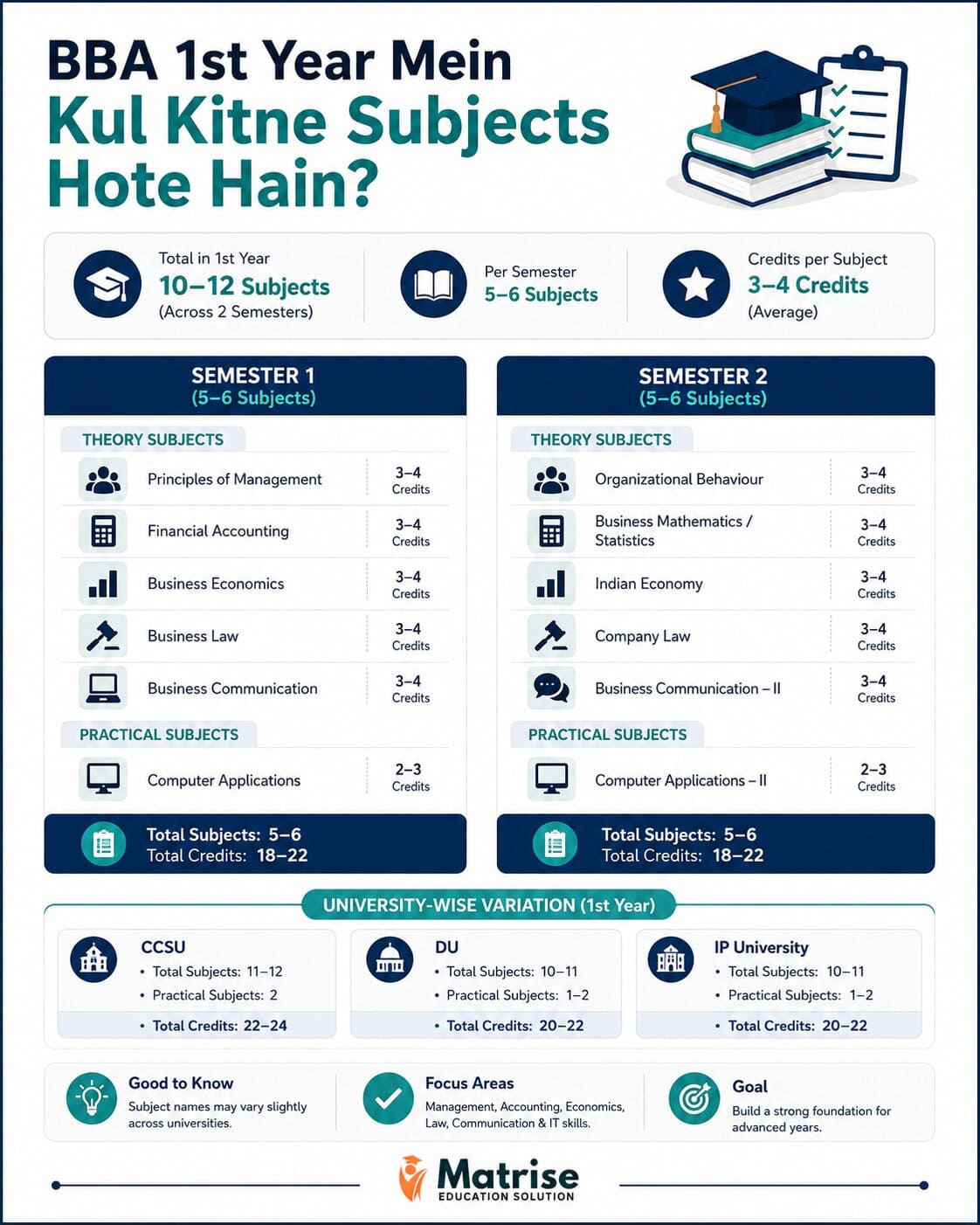
This is the most common question students ask. The BBA course subjects list 1st year usually contains 10 to 12 subjects in total. These are divided equally between Semester 1 and Semester 2. Most universities follow a similar pattern, though minor variations exist.
Theory vs Practical Subjects Breakdown
Out of these 10–12 subjects, around 8 to 9 are theory-based. Only 1 to 2 subjects have practical or lab components. Computer Applications in Business is the most common practical subject. Some universities also include a project or presentation as part of internal assessment.
Credit System Explained Simply
Each subject carries credits. Typically, a theory subject has 4 credits. A practical subject may have 2 credits. Your total credits per semester range from 20 to 24. Credits matter because your CGPA depends on them. More credits mean more weightage in your overall grade.
University-Wise Slight Variations
Universities like CCSU, DU, and IP University follow the UGC approved BBA curriculum guidelines. However, the subject names or order may differ slightly. For example, CCSU may teach Business Law in Semester 1, while DU teaches it in Semester 2. The core concepts remain the same across all universities. If you are looking for the BBA admission 2026 process, Matrise has a detailed guide for that too.
BBA Semester 1 Subjects List
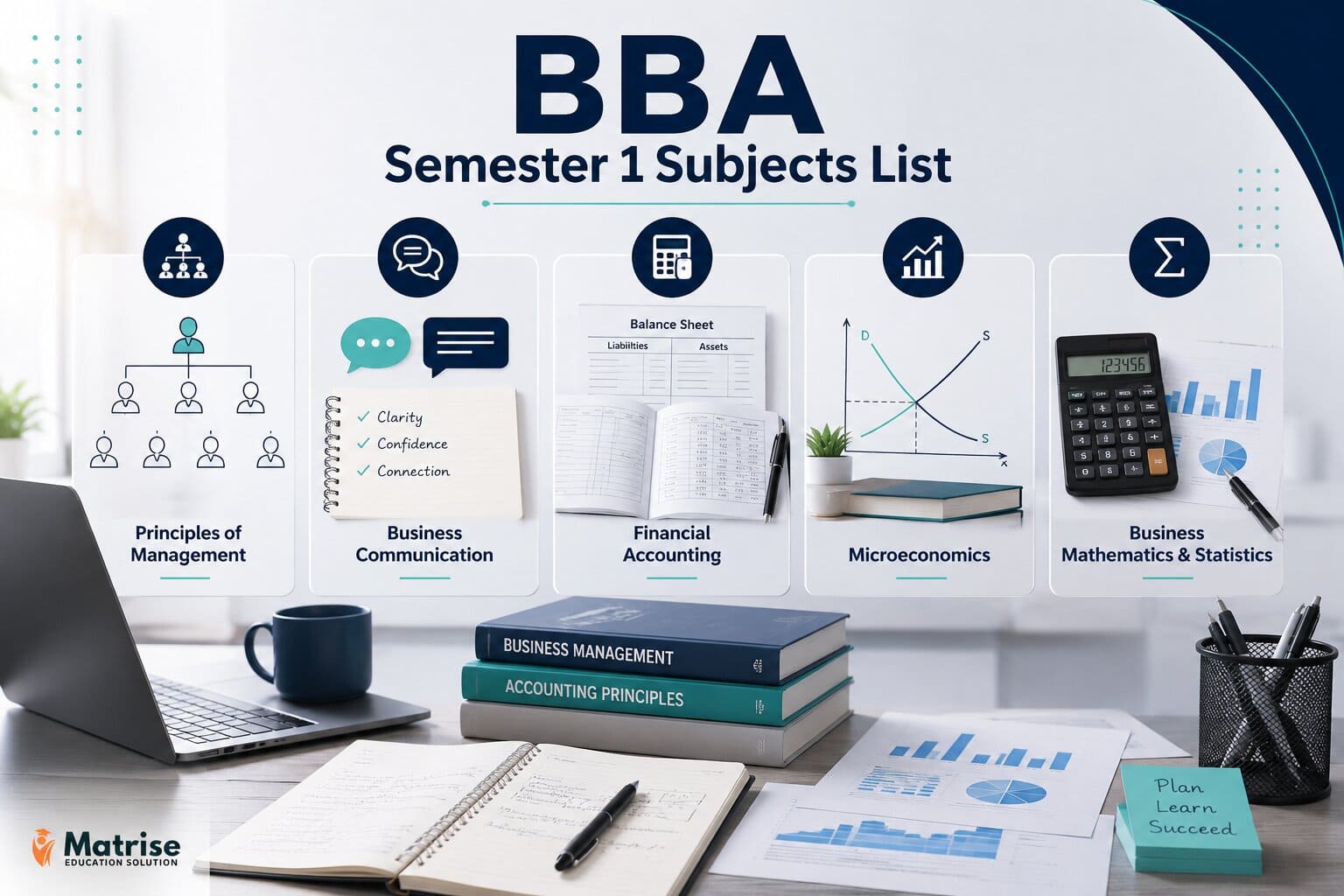
The BBA semester 1 subjects focus on building a basic understanding of business and management. Here is a detailed look at each subject you will study in the first semester of BBA.
Principles of Management
Principles of Management BBA is the first and most important subject in your BBA journey. It introduces you to what management actually means. You learn about the four pillars: Planning, Organizing, Directing, and Controlling.
Key topics covered:
- Functions of management
- Management theories (Fayol, Taylor)
- Decision-making process
- Leadership styles
Real-life example: Think about how a company like Zomato manages thousands of delivery partners. That is management in action — planning routes, organizing teams, directing operations, and controlling quality.
Student Tip: Make short notes of Fayol’s 14 Principles. They are asked in almost every exam.
Business Communication
Business communication BBA subject teaches you how professionals talk and write in the corporate world. You learn both oral and written communication skills.
Key topics covered:
- Business letters and email writing
- Report writing
- Presentation skills
- Barriers to communication
- Non-verbal communication
This subject matters a lot for placements later. Companies always prefer candidates who communicate clearly. Even in your first year, developing this skill gives you an advantage.
Student Tip: Practice writing one formal email every week. It builds confidence and speed for exams.
Financial Accounting
Financial Accounting BBA is the subject that students either love or fear. It depends largely on your background. Commerce students usually find it easy. Non-commerce students may struggle initially, but consistent practice helps.
Key topics covered:
- Basic accounting concepts and conventions
- Journal entries and ledger posting
- Trial balance preparation
- Balance Sheet and Profit & Loss statement
- Depreciation methods
Student Tip: Solve at least 5 journal entry problems daily during exam season. Accounting is about practice, not memorization.
Microeconomics
Microeconomics BBA is about understanding how individuals and businesses make decisions. It focuses on small-scale economic behavior.
Key topics covered:
- Demand and Supply theory
- Consumer behavior and utility
- Market structures (Perfect competition, Monopoly)
- Price determination
- Elasticity of demand
Real-life connection: When Ola increases ride prices during rain, that is demand-supply at work. You will study exactly why this happens.
Student Tip: Draw demand-supply diagrams. Visual learning helps remember concepts faster.
Business Mathematics & Statistics
Business Mathematics BBA is the subject many students worry about. But honestly, the math in BBA is much simpler than what you studied in 11th and 12th.
Key topics covered:
- Sets and Matrices
- Probability basics
- Mean, Median, Mode
- Standard Deviation
- Simple and compound interest
Calculator tip: Most universities allow calculators in exams. Learn shortcut methods for faster calculations.
Student Tip: Focus on formulas first. Make a formula sheet and revise it every morning during exams.
BBA Semester 2 Subjects List
The BBA semester 2 subjects go deeper into business concepts. You move from individual-level understanding to organizational and legal frameworks. Here is the detailed BBA 2nd semester subjects breakdown.
Macroeconomics
If Microeconomics studies trees, Macroeconomics studies the entire forest. This subject looks at the economy as a whole.
Key topics covered:
- GDP and National Income
- Inflation and deflation
- Monetary and Fiscal Policy
- International trade basics
- Government budgeting
Difference from Microeconomics: Micro focuses on individual consumers and firms. Macro focuses on the entire country’s economic health.
Real-life connection: When RBI changes interest rates, it affects your home loan EMI. Macroeconomics explains why this happens.
Business Law / Legal Aspects of Business
This subject introduces you to the legal framework of Indian business. You learn about important acts that govern commercial activities.
Key topics covered:
- Indian Contract Act, 1872
- Sale of Goods Act, 1930
- Consumer Protection Act
- Partnership Act
- Essential elements of a valid contract
Case study example: If a supplier delivers damaged goods and refuses refund, which law protects the buyer? You will learn exactly this in Business Law.
Student Tip: Use case-based learning. Real court cases make this subject interesting and easier to remember.
Computer Applications in Business
This is one of the few practical subjects in the BBA course subjects list 1st year. It teaches you essential digital tools used in modern businesses.
Key topics covered:
- MS Word, Excel, PowerPoint
- Basic database concepts
- Internet and email usage in business
- Introduction to MIS (Management Information Systems)
Most colleges have lab sessions for this subject. You get hands-on practice with Excel formulas, chart creation, and presentation design.
Student Tip: Learn Excel shortcuts. Companies love candidates who can work efficiently with spreadsheets.
Organizational Behavior
OB is all about understanding how people behave in workplace settings. It is closely related to HR management.
Key topics covered:
- Individual behavior and perception
- Group dynamics and team management
- Motivation theories (Maslow’s hierarchy, Herzberg’s two-factor theory)
- Leadership and power
- Organizational culture and change
Why it matters: If you plan a career in HR or management, OB is your most valuable subject. It teaches you how to lead, motivate, and manage teams.
Environmental Studies / Business Ethics
This subject covers sustainability, corporate responsibility, and ethical business practices. It is compulsory across almost all Indian universities.
Key topics covered:
- Environmental pollution and conservation
- Sustainable development concepts
- Corporate Social Responsibility (CSR)
- Business ethics and moral values
Student Tip: This is an easy scoring subject. Focus on definitions and key terms. Write your answers in points for better marks.
BBA 1st Year Subjects Mein Kaun Sa Sabse Mushkil Hai?
Based on feedback from thousands of BBA students across India, here is the difficulty ranking of BBA 1st year subjects:
| Subject | Difficulty Level | Toughest For |
|---|---|---|
| Financial Accounting | High | Non-Commerce students |
| Business Mathematics | Medium-High | Arts background students |
| Microeconomics | Medium | Students weak in graphs |
| Business Law | Medium | Students who dislike rote learning |
| Principles of Management | Easy-Medium | Most students find it manageable |
| Environmental Studies | Easy | Almost no one finds it tough |
Key insight: If you are from a non-commerce background, start preparing Financial Accounting and Business Mathematics from the very first week. Do not wait until exams approach. Early preparation makes these subjects much easier.
Also, many students from Arts background worry about BBA difficulty. The truth is — BBA 1st year arts student kar sakta hai bilkul easily. The subjects are designed for beginners. Consistent effort is all you need.
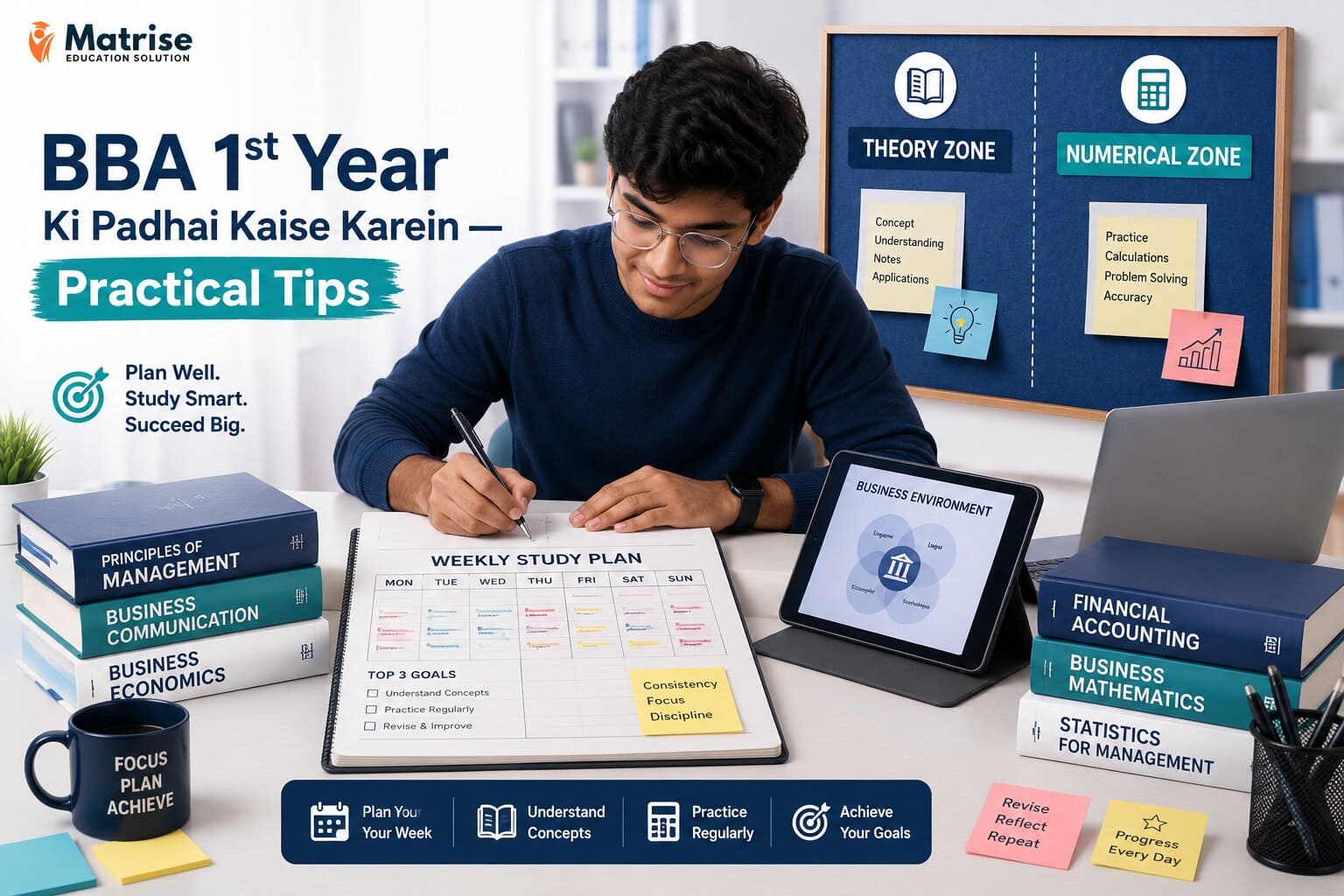
BBA 1st Year Ki Padhai Kaise Karein — Practical Tips
Knowing the BBA course subjects 1st year is just the first step. The real question is — how should you study them effectively? Here is a practical, step-by-step approach.
Step 1: Categorize Subjects by Type
Divide your subjects into three categories:
- Numerical: Financial Accounting, Business Mathematics
- Conceptual: Microeconomics, Macroeconomics, Organizational Behavior
- Theory-heavy: Principles of Management, Business Law, Environmental Studies
Step 2: Create a Weekly Study Schedule
Here is a suggested weekly plan:
| Day | Focus Area | Duration |
|---|---|---|
| Monday | Accounting Practice | 2 hours |
| Tuesday | Economics Concepts | 1.5 hours |
| Wednesday | Mathematics Problems | 2 hours |
| Thursday | Management & OB Theory | 1.5 hours |
| Friday | Business Law Cases | 1.5 hours |
| Saturday | Revision + Weak Areas | 2 hours |
| Sunday | Rest / Light Reading | Optional |
Step 3: Use the Right Reference Books
Here are the best reference books for BBA 1st year subjects:
- Principles of Management: P.C. Tripathi & P.N. Reddy
- Financial Accounting: R.L. Gupta & M. Radhaswamy
- Business Communication: Urmila Rai & S.M. Rai
- Microeconomics: H.L. Ahuja
- Business Mathematics: J.K. Singh
- Business Law: N.D. Kapoor
- Organizational Behavior: Stephen P. Robbins
Step 4: Choose Notes Format Wisely
Handwritten notes work best for theory subjects like Management and Law. For numerical subjects, maintain a separate problem-solving notebook. Digital notes using apps like Notion or Google Docs are great for quick revision before exams.
BBA 1st Year Ke Baad Kya Milta Hai — Skills & Knowledge
Completing the BBA 1st year subjects list successfully gives you more than just marks. Here is what you gain:
- Business fundamentals: You understand how companies work, from management to accounting.
- Communication skills: Business Communication makes you confident in professional settings.
- Analytical thinking: Economics and Mathematics sharpen your problem-solving ability.
- Legal awareness: Business Law gives you basic legal knowledge for entrepreneurship.
- Digital literacy: Computer Applications prepares you for modern workplace tools.
After 1st year, you move to specializations in 2nd and 3rd year. These include Finance, Marketing, HR, and International Business. Your 1st year foundation directly impacts how well you perform in these specializations.
Many students also start internships after BBA 1st year. Companies prefer students with strong fundamentals — exactly what the first year teaches you. If you plan to pursue MBA after BBA, your 1st year subjects actually overlap with MBA entrance exam syllabus. Check out MBA subjects after BBA for a detailed comparison.
University-Wise BBA 1st Year Subject Comparison
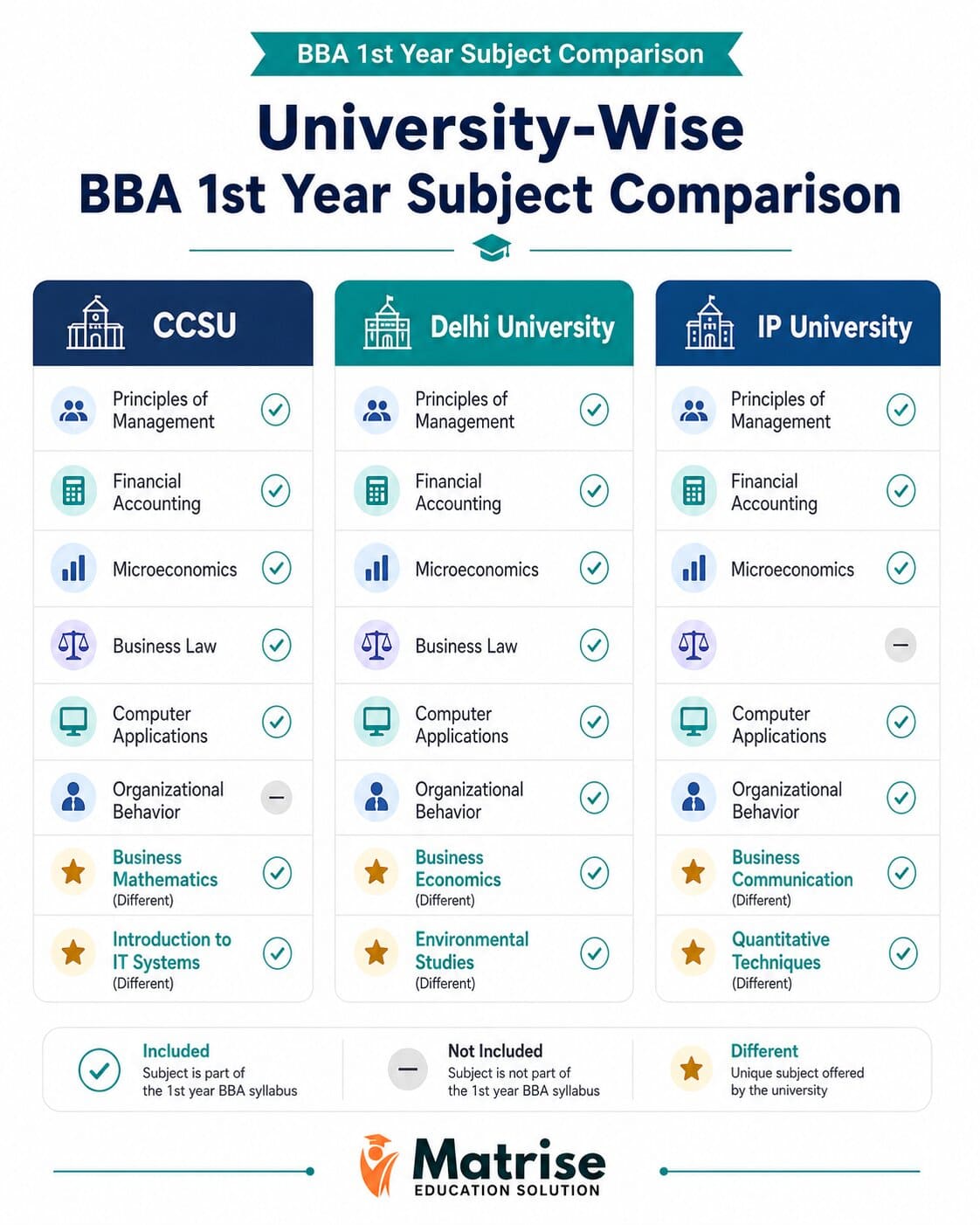
Different universities in India follow slightly different syllabi. However, the BBA core subjects remain largely the same. Here is a comparison of the BBA subjects list semester wise across popular universities. You can also check the CCSU BBA official syllabus for the latest updates.
| Subject | CCSU | Delhi University | IP University |
|---|---|---|---|
| Principles of Management | ✅ Sem 1 | ✅ Sem 1 | ✅ Sem 1 |
| Financial Accounting | ✅ Sem 1 | ✅ Sem 1 | ✅ Sem 1 |
| Business Communication | ✅ Sem 1 | ✅ Sem 2 | ✅ Sem 1 |
| Microeconomics | ✅ Sem 1 | ✅ Sem 1 | ✅ Sem 2 |
| Business Mathematics | ✅ Sem 1 | ✅ Sem 1 | ✅ Sem 1 |
| Macroeconomics | ✅ Sem 2 | ✅ Sem 2 | ✅ Sem 2 |
| Business Law | ✅ Sem 2 | ✅ Sem 2 | ✅ Sem 2 |
| Computer Applications | ✅ Sem 2 | ✅ Sem 1 | ✅ Sem 2 |
| Organizational Behavior | ✅ Sem 2 | ✅ Sem 2 | ✅ Sem 2 |
| Environmental Studies | ✅ Sem 2 | ✅ Sem 1 | ✅ Sem 2 |
As you can see, the subjects are almost identical. Only the semester placement changes slightly. For a more comprehensive reference, you can also explore BBA syllabus overview by Shiksha which covers multiple universities.
Matrise Insight: No matter which university you choose, the BBA course subjects list 1st year prepares you equally well. Focus on understanding concepts rather than worrying about university-specific differences. Matrise provides university-specific guides to help students navigate these small variations easily.
Frequently Asked Questions (FAQ)
BBA 1st year mein kaunse subjects hote hain?
BBA 1st year mein typically Principles of Management, Financial Accounting, Business Communication, Microeconomics, Business Mathematics, Macroeconomics, Business Law, Computer Applications, Organizational Behavior, and Environmental Studies padhaye jaate hain. Ye BBA 1st year subjects list most Indian universities mein common hai.
BBA semester 1 aur semester 2 mein kya difference hota hai?
Semester 1 focuses on foundational subjects like Management, Accounting, and Microeconomics. Semester 2 moves to broader topics like Macroeconomics, Business Law, and Organizational Behavior. Semester 1 individual-level concepts cover karta hai, jabki Semester 2 organizational aur legal aspects pe focus karta hai.
BBA 1st year mein kitne subjects hote hain total?
BBA 1st year mein total 10 se 12 subjects hote hain. Ye dono semesters mein equally divided hote hain — approximately 5 to 6 subjects per semester. Kuch universities mein additional elective ya language subject bhi hota hai.
Kya BBA 1st year mein Maths compulsory hoti hai?
Haan, Business Mathematics BBA zyaadatar universities mein compulsory hoti hai. Lekin ye advanced maths nahi hai. Basic sets, matrices, probability, aur statistics cover hoti hai. Arts ya Commerce background ke students bhi isse handle kar sakte hain with regular practice.
BBA 1st year ke liye best reference books kaun si hain?
Best books include: P.C. Tripathi for Management, R.L. Gupta for Financial Accounting, H.L. Ahuja for Microeconomics, N.D. Kapoor for Business Law, and Stephen P. Robbins for Organizational Behavior. Always confirm with your university’s recommended book list as well.
CCSU BBA 1st year subjects list kya hai?
CCSU (Chaudhary Charan Singh University) BBA 1st year mein Principles of Management, Financial Accounting, Business Communication, Microeconomics, aur Business Mathematics Semester 1 mein padhaye jaate hain. Semester 2 mein Macroeconomics, Business Law, Computer Applications, Organizational Behavior, aur Environmental Studies hote hain.
BBA 1st year arts student kar sakta hai kya?
Bilkul haan! BBA mein admission ke liye Commerce background zaroori nahi hai. Arts aur Science students bhi BBA kar sakte hain. Haan, Accounting aur Maths mein thoda extra effort lagana padega, lekin subjects beginner-friendly design kiye gaye hain.
BBA 1st year mein Financial Accounting mushkil hoti hai kya?
Commerce students ke liye ye relatively easy hoti hai kyunki unhe basic accounting already pata hoti hai. Non-commerce students ko initially challenging lag sakti hai. Lekin agar aap daily practice karein aur journal entries solve karein, toh ye manageable hai.
BBA 1st year mein passing marks kitne hone chahiye?
Most Indian universities mein BBA 1st year ka passing percentage 33% to 40% hota hai. Some universities follow CGPA system where minimum CGPA 4.0 (out of 10) required hota hai. Internal aur external marks ka combined total count hota hai.
BBA 1st year ki fees kitni hoti hai India mein?
Government colleges mein BBA 1st year ki fees ₹10,000 se ₹25,000 per year hoti hai. Private colleges mein ye ₹50,000 se ₹2,00,000 per year tak ho sakti hai. Fee structure university aur location ke hisaab se vary karti hai.
BBA aur BCA 1st year subjects mein kya difference hai?
BBA 1st year mein Management, Accounting, Economics, aur Business Law padhte hain. BCA 1st year mein Programming Languages (C, C++), Data Structures, Computer Fundamentals, aur Web Technology padhte hain. BBA business-oriented hai jabki BCA technology-oriented hai.
BBA 1st year ke baad kya karte hain students?
BBA 1st year ke baad students 2nd year mein specializations choose karte hain — jaise Finance, Marketing, ya HR. Kuch students summer internships karte hain. Kuch part-time jobs ya freelancing bhi start karte hain apni communication aur management skills use karke.
Conclusion — Your BBA 1st Year Journey Starts Here
The BBA course subjects list 1st year might seem overwhelming at first glance. But when you break it down semester-wise, it becomes completely manageable. Semester 1 builds your business basics. Semester 2 expands your understanding to the economy, law, and organizational dynamics.
The key is to start early, stay consistent, and use the right resources. Whether you are from Commerce, Arts, or Science background — BBA 1st year is designed to bring everyone to the same level. The subjects are meant for beginners, and every student can score well with proper planning.
Matrise is here to make your BBA journey smoother. From subject guides to admission help, from BBA syllabus 2026 updates to career planning — Matrise covers everything. Our detailed guides are written by education experts who understand what Indian students actually need.
What should you do next?
- Bookmark this page for quick reference throughout the year.
- Share it with your classmates and study group.
- Explore more BBA resources on Matrise to stay ahead in your academic journey.
Your BBA 1st year is the foundation. Build it strong, and the rest of your career will thank you.