
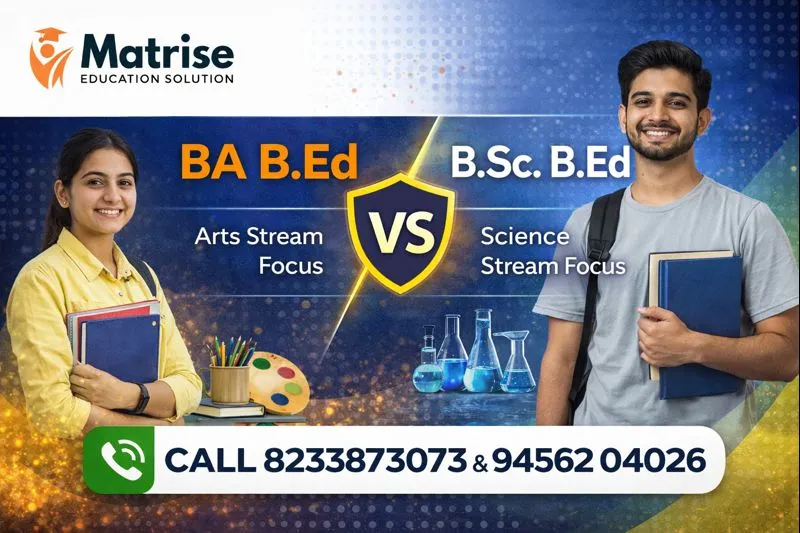
BA B.Ed vs B.Sc. B.Ed — this is one of the most common dilemmas faced by students who want to build a career in teaching after Class 12. Both are 4-year integrated programs that combine a subject degree with professional teacher training. But they differ significantly in their subject streams, career outcomes, and teaching eligibility. This complete guide by Matrise breaks down every important difference so you can choose the right path with full confidence.
If you are already planning to apply, you can explore the full details on BA B.Ed Admission 2026 to get started with the process right away.
BA B.Ed Vs B.Sc. B.Ed — Key Differences Explained
Both courses are approved by the National Council for Teacher Education (NCTE) and recognized across India. The core difference lies in the subject stream. BA B.Ed is designed for students from the Arts and Humanities stream, while B.Sc. B.Ed is built for students who studied Science subjects in Class 11 and 12.
According to Wikipedia’s overview of the Bachelor of Education degree, integrated B.Ed programs were introduced to reduce the time taken to qualify as a teacher and to improve the quality of teacher training across India.
Here is a side-by-side overview of both programs at a glance:
| Feature | BA B.Ed | B.Sc. B.Ed |
|---|---|---|
| Stream | Arts / Humanities | Science / Mathematics |
| Duration | 4 Years (Integrated) | 4 Years (Integrated) |
| Eligibility | Class 12 (Arts/Any Stream) with 50% marks | Class 12 (Science Stream) with 50% marks |
| Core Subjects | History, Geography, Political Science, Hindi, English, Economics | Physics, Chemistry, Biology, Mathematics, Computer Science |
| Teaching Level | Secondary & Senior Secondary (Classes 6–12) | Secondary & Senior Secondary (Classes 6–12) |
| TET Eligibility | Yes (Paper II – Social Studies/Languages) | Yes (Paper II – Science/Mathematics) |
| Top Career Roles | TGT (Social Studies, Hindi, English), School Counsellor | TGT (Science, Maths), Lab Assistant, Science Educator |
| Average Salary (Govt.) | ₹25,000 – ₹40,000/month | ₹28,000 – ₹45,000/month |
| Higher Study Options | MA, M.Ed, MBA (Education) | M.Sc., M.Ed, MBA (Education) |
| Admission Mode | Entrance Exam / Merit-Based | Entrance Exam / Merit-Based |
What is BA B.Ed? Full Details
BA B.Ed 2026 is a 4-year integrated undergraduate degree that combines a Bachelor of Arts with the Bachelor of Education. It is ideal for students who love humanities subjects and want to become trained secondary school teachers without spending extra years doing both degrees separately.
Subjects in BA B.Ed
- History, Geography, Political Science
- Hindi Language and Literature
- English Language and Communication
- Economics and Social Studies
- Education Theory and Pedagogy
- Child Development and Psychology
- School Internship / Teaching Practice
Who Should Choose BA B.Ed?
- Students from the Arts stream in Class 12
- Candidates who want to teach Social Studies, Hindi, English, or History
- Those who prefer working with language, culture, and humanities
- Students aiming for TGT (Trained Graduate Teacher) roles in Social Studies or Languages
For state-wise admission details including important dates and fees, visit our comprehensive guide on UP B.Ed Admission 2026 – Dates, Fees, Eligibility & Colleges.
What is B.Sc. B.Ed? Full Details
B.Sc. B.Ed 2026 is a 4-year integrated program that merges a Bachelor of Science degree with the Bachelor of Education qualification. It is designed for students who studied Physics, Chemistry, Biology, or Mathematics in Class 12 and want to become qualified science or math teachers.
Subjects in B.Sc. B.Ed
- Physics, Chemistry, Biology (or Mathematics)
- Computer Science / Information Technology
- Education Theory and Pedagogy
- Environmental Science
- Teaching Methods for Science and Mathematics
- Child Development and Learning Psychology
- School Internship / Practical Teaching Sessions
Who Should Choose B.Sc. B.Ed?
- Students from the Science stream in Class 12 (PCM or PCB)
- Candidates who want to teach Physics, Chemistry, Biology, or Mathematics
- Those who want to appear in TGT Science or TGT Mathematics government exams
- Students who enjoy logical reasoning, lab work, and scientific thinking
BA B.Ed vs B.Sc. B.Ed — Eligibility Criteria 2026
Both courses have similar eligibility requirements with one key difference — the required stream in Class 12:
| Eligibility Criteria | BA B.Ed | B.Sc. B.Ed |
|---|---|---|
| Class 12 Stream | Arts / Humanities (any stream in some colleges) | Science (PCM or PCB mandatory) |
| Minimum Marks | 50% aggregate (45% for reserved category) | 50% aggregate (45% for reserved category) |
| Age Limit | Minimum 17 years (varies by university) | Minimum 17 years (varies by university) |
| Admission Process | State Entrance Exam or Merit List | State Entrance Exam or Merit List |
| NCTE Approval Required | Yes | Yes |
Career Scope — BA B.Ed vs B.Sc. B.Ed
Both degrees open strong government and private sector teaching careers. However, the specific job roles differ based on the subject stream. Here is a breakdown of the career options available after each course:
Career Options After BA B.Ed
- TGT (Social Studies): Teach History, Geography, and Civics in Classes 6–10
- TGT (Hindi / English): Language teacher in government or private schools
- School Counsellor: Career guidance and student welfare roles
- Educational Content Writer: Create learning material for EdTech companies
- CTET/State TET Qualified Teacher: Primary or upper primary government posts
- NGO Educator: Work in community learning programs and social sector
Career Options After B.Sc. B.Ed
- TGT (Science/Mathematics): Teach Physics, Chemistry, Biology, or Maths in Classes 6–10
- PGT (after M.Sc.): Post-Graduate Teacher in Classes 11–12
- Lab Technician / Science Coordinator: Manage school science labs
- STEM Educator: Work with EdTech and STEM-focused organizations
- Research Assistant: Support academic or government research projects
- Online Tutor: Teach Science and Math on platforms like Vedantu, BYJU’s, Unacademy
Many students and professionals have shared their real experiences comparing both paths on Quora’s discussion thread on B.Sc. B.Ed vs BA B.Ed — a useful read before making your decision.
Salary After BA B.Ed and B.Sc. B.Ed in India
One of the most searched questions is what is the B.Sc. salary after completing B.Sc. B.Ed or the salary after BA B.Ed. Here is a realistic picture of earnings in 2026:
| Job Role | Sector | Monthly Salary (Approx.) |
|---|---|---|
| TGT (Science / Maths) — B.Sc. B.Ed | Government | ₹28,000 – ₹45,000 |
| TGT (Social Studies / Hindi) — BA B.Ed | Government | ₹25,000 – ₹40,000 |
| Private School Teacher (Science) | Private | ₹20,000 – ₹35,000 |
| Private School Teacher (Arts) | Private | ₹18,000 – ₹30,000 |
| Online Tutor (STEM) | EdTech / Freelance | ₹25,000 – ₹60,000 |
| Education Content Developer | Private / EdTech | ₹25,000 – ₹50,000 |
| Corporate Trainer | Corporate | ₹40,000 – ₹80,000 |
Government school teachers with experience and pay commission benefits can see salaries grow significantly over time, with senior TGT positions often earning ₹50,000+ per month after 5–10 years of service.
Which is Better — BA B.Ed or B.Sc. B.Ed?
This is the most searched question and the honest answer is: neither is universally better — it depends on your stream, interests, and career goal.
- Choose BA B.Ed if: You studied Arts in Class 12, love humanities subjects like History, Geography, Hindi, or English, and want to teach Social Studies or Languages in school
- Choose B.Sc. B.Ed if: You studied Science in Class 12, love subjects like Physics, Chemistry, Biology, or Maths, and want to teach Science or Mathematics in secondary classes
- Job availability: Both streams have strong government job openings via TGT recruitment but Science and Maths teachers are often in higher demand in urban schools
- Salary edge: B.Sc. B.Ed graduates typically command slightly higher salaries, especially in private schools and EdTech platforms, due to demand for STEM educators
- Flexibility: BA B.Ed graduates have broader options in language teaching, journalism, NGO work, and government administration roles alongside teaching
Benefits of Choosing an Integrated B.Ed Program
Both BA B.Ed and B.Sc. B.Ed offer the major advantage of being integrated programs. This means you complete your subject degree and teacher training simultaneously in 4 years instead of the traditional 5 to 6 years (3-year degree + 2-year B.Ed separately).
- Time-Saving: Save 1–2 years compared to the traditional route
- Cost-Effective: Single fee structure — no need to pay for two separate programs
- NCTE Recognized: Both are fully valid for TET, CTET, and government teaching jobs
- Dual Qualification: Graduate with both a subject degree and a teaching license
- Better Campus Exposure: 4 years of teaching practice and school internship experience
- Higher Confidence: Longer integrated training builds stronger classroom skills
To make sure you don’t miss application deadlines and get proper guidance on admissions, trust Matrise — India’s growing education resource platform that publishes verified, up-to-date admission guides for every state and every course.
How Matrise Helps You Choose and Apply
Matrise understands that choosing between BA B.Ed and B.Sc. B.Ed can feel overwhelming. That’s why our expert team publishes clear, bias-free guides that walk you through every detail — from understanding the course structure to comparing colleges, fees, and career outcomes.
Here’s how Matrise supports your teaching career journey:
- State-Wise Admission Guides: UP, Bihar, Delhi, MP, Rajasthan and more — all in one place
- Course Comparison Blogs: Honest comparisons so you make the right choice
- Exam & Notification Updates: Never miss a deadline with our timely posts
- College Reviews & Rankings: Know which colleges offer the best placements and training
- Career Roadmaps: Step-by-step guides from enrollment to your first government teaching job
Explore more teaching career tools, study resources, and coaching options through VGI Group on Linktree — a trusted partner for teacher training aspirants across India.
Frequently Asked Questions — BA B.Ed vs B.Sc. B.Ed
It depends entirely on your subject interest. B.Sc. B.Ed is better if you want to teach Science or Mathematics. BA B.Ed is better if you prefer teaching Social Studies, Languages, History, or Arts subjects at the secondary level.
BA and B.Ed serve different purposes. A plain BA is a general arts degree with broad career options. B.Ed is a professional teaching degree. If you want a career in school teaching, the integrated BA B.Ed is the most efficient and smart choice.
B.Sc. is a pure science subject degree with broader research and industry career options. B.Ed is a teacher training degree. If your goal is to become a school teacher, B.Sc. B.Ed (integrated) gives you both in 4 years and is the smarter route.
A B.Sc. B.Ed graduate working as a government TGT earns between ₹28,000 to ₹45,000 per month. In private schools, starting salaries range from ₹20,000 to ₹35,000/month. Online tutors and EdTech educators can earn ₹40,000 to ₹60,000+ per month.
Both BA B.Ed and B.Sc. B.Ed are 4-year integrated degree programs. They combine the undergraduate subject degree with professional teacher training in one go, saving you 1–2 years compared to doing both courses separately.
Yes. Graduates of both programs are eligible to appear for CTET, State TET, and TGT recruitment exams. After clearing these, you can apply for government school teacher positions. B.Sc. B.Ed qualifies you for TGT Science/Maths, and BA B.Ed qualifies for TGT Social Studies/Languages.
BA B.Ed covers History, Geography, Political Science, English, Hindi, and Education. B.Sc. B.Ed covers Physics, Chemistry, Biology, Mathematics, and Education with Pedagogy subjects. Both include school teaching internship and child psychology modules.