
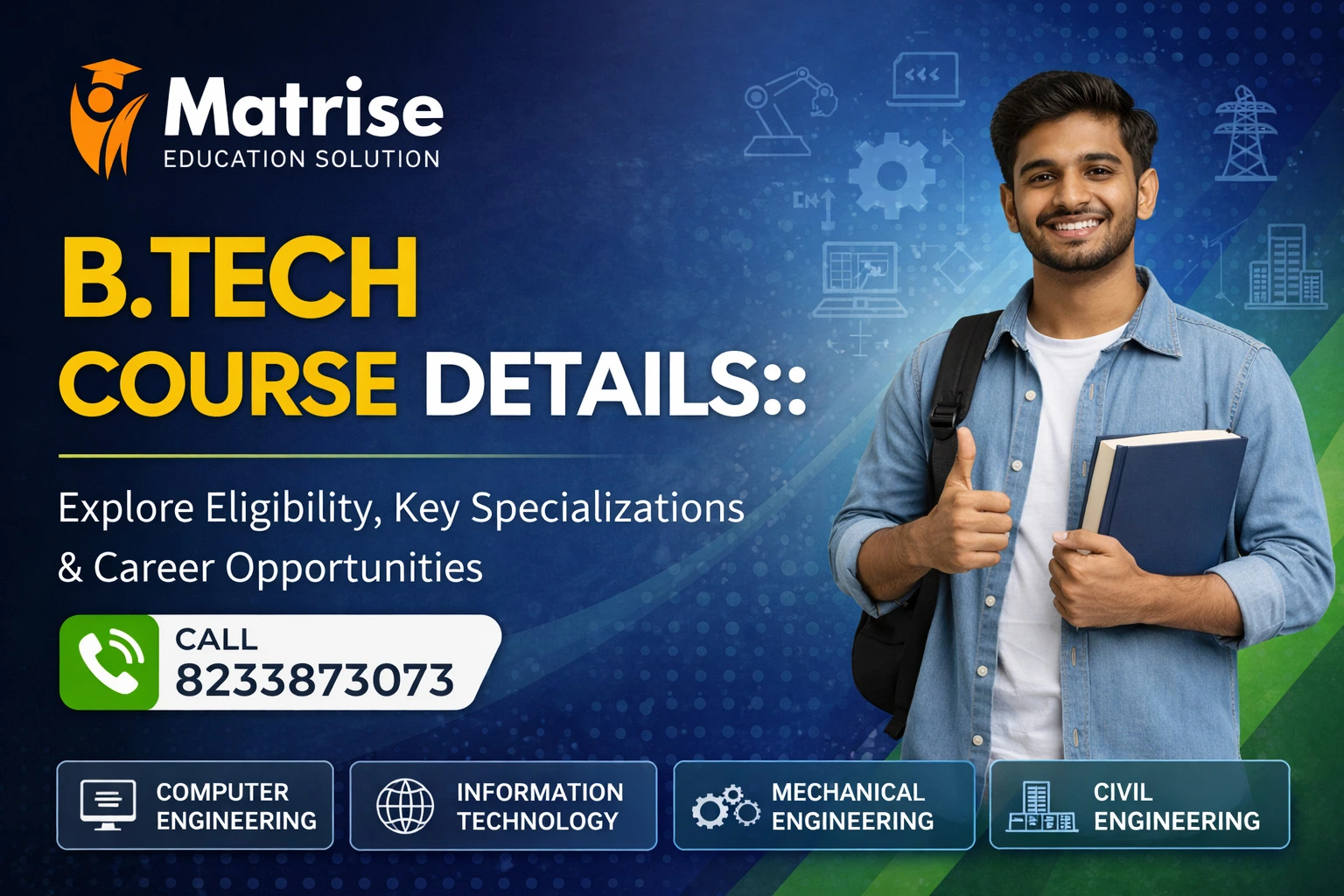
B.Tech course details are the first thing every student searches for after completing Class 12 — and for good reason. B.Tech (Bachelor of Technology) is a 4-year undergraduate engineering degree that opens doors to some of the most in-demand and high-paying careers in India and abroad. Whether you want to become a software engineer, mechanical designer, AI specialist, or civil engineer, this single degree can set your entire career direction. At Matrise, we help students find the right engineering path — from course selection to college admission guidance — all in one place.
B.Tech Course Details: Complete Overview for 2026
B.Tech is a professional undergraduate degree in engineering and technology. It is approved by AICTE (All India Council for Technical Education) and recognized by universities across India. The course covers both theoretical knowledge and practical lab-based learning, making graduates job-ready from day one.
Here is a quick overview of key B.Tech course details:
- Full Form: Bachelor of Technology
- Course Level: Undergraduate (UG)
- Duration: 4 years (8 semesters) | 3 years via lateral entry after diploma
- Eligibility: 10+2 with Physics, Chemistry, and Mathematics (PCM) — minimum 50–60% marks
- Entrance Exams: JEE Main, JEE Advanced, BITSAT, UPTAC (for UP students), CUET
- Average Fees: ₹2 lakh – ₹15 lakh (varies by college type)
- Average Starting Salary: ₹5.9 LPA (higher for top colleges and premium branches)
- Top Recruiting Companies: TCS, Infosys, Wipro, Google, Microsoft, L&T, ISRO
If you want full details on fees and eligibility for B.Tech admission 2026, check out the complete guide on B.Tech Admission 2026: Date, Fees, Eligibility, Documents & Colleges.
🎓 Start Your B.Tech Journey Today
Get Expert B.Tech Guidance — Free & Instant!
Connect with Matrise counsellors on WhatsApp. No forms, no fees — just clear, honest guidance on course selection, admission, and college options near you.
- ✅ Free course counselling
- ✅ No technical skills required to get started
- ✅ Admission support for government & private colleges
- ✅ Guidance for UP, Delhi, Meerut & all India
B.Tech Course Duration and Fees
The standard B.Tech course duration is 4 years, which equals 8 semesters. Each semester is 6 months long and includes examinations at the end. For diploma holders who want to skip the first year, a lateral entry option is available — this reduces the course duration to 3 years (6 semesters).
Here is a clear comparison of B.Tech course duration and fees based on college type:
| College Type | Duration | Total Fees (4 Years) | Fees Per Year (Approx.) |
|---|---|---|---|
| Government Colleges | 4 Years | ₹2 – ₹6 Lakh | ₹50,000 – ₹1.5 Lakh |
| IITs | 4 Years | ₹8 – ₹10 Lakh | ₹2 – ₹2.5 Lakh |
| Private Colleges | 4 Years | ₹4 – ₹15 Lakh | ₹1 – ₹3.75 Lakh |
| Lateral Entry (After Diploma) | 3 Years | ₹2.5 – ₹8 Lakh | ₹80,000 – ₹2.6 Lakh |
| Near Meerut / UP (Private) | 4 Years | ₹25,000 – ₹4.65 Lakh | ₹6,250 – ₹1.16 Lakh |
For a deep dive into fees across India, read our detailed article on B.Tech Course Fees in India — covering government colleges, private universities, and scholarship options.
B.Tech Courses List – Top Specialisations in 2026
India offers more than 40 B.Tech specialisations across thousands of AICTE-approved colleges. The right branch depends on your interest, career goal, and the job market. Below are the most popular and future-proof B.Tech courses available today:
Core B.Tech Branches
- B.Tech Computer Science Engineering (CSE)
- B.Tech Mechanical Engineering
- B.Tech Civil Engineering
- B.Tech Electrical Engineering
- B.Tech Electronics & Communication Engineering (ECE)
- B.Tech Chemical Engineering
- B.Tech Information Technology (IT)
- B.Tech Aeronautical / Aerospace Engineering
- B.Tech Biotechnology
- B.Tech Automobile Engineering
High-Demand B.Tech Specialisations (2026)
- B.Tech CSE – Artificial Intelligence & Machine Learning (AI/ML)
- B.Tech CSE – Data Science
- B.Tech CSE – Cybersecurity & Forensics
- B.Tech CSE – Cloud Computing & DevOps
- B.Tech ECE – Internet of Things (IoT)
- B.Tech Mechanical – Robotics & Smart Manufacturing
- B.Tech – Renewable Energy Engineering
Curious about which branch suits you best? Experts and students have shared their experiences on Quora – Which course is best for B.Tech students, and the verdict is clear: choose based on passion, not just salary trends.
BTech Admission Process – Step by Step Guide
Getting B.Tech admission in 2026 follows a clear and structured process. Whether you are applying through JEE Main or through direct admission at private universities, here is what every student needs to do:
- Check Eligibility: Pass Class 12 with PCM and a minimum of 50–60% aggregate marks (45% for reserved categories in some states).
- Register for Entrance Exams: Apply for JEE Main (national level), state-level exams like UPTAC (Uttar Pradesh), or university-specific tests.
- Download Admit Card and Appear for Exam: Follow all exam centre instructions. JEE Main is conducted twice a year — in January and April sessions.
- Check Result and Percentile: Based on your score, you will be assigned a rank for counselling.
- Participate in Counselling: Register on the official counselling portal, fill in your branch and college preferences, and lock choices.
- Document Verification: Submit required documents — Class 10 & 12 marksheets, category certificate (if applicable), ID proof, and passport photos.
- Pay Admission Fees and Confirm Seat: Pay the first-semester or full admission fee to confirm your seat in the allotted college.
B.Tech application forms and online dates for 2026 are now open for most universities. Do not miss the deadlines — read the full schedule on our B.Tech Admission 2026 guide.
B.Tech Subjects – What Will You Study?
The B.Tech curriculum is divided into four phases — foundation, core, specialisation, and final year project. In the first two years, all students study common engineering subjects. From the third year onwards, the syllabus becomes specific to your branch.
Common First-Year B.Tech Subjects
- Engineering Mathematics (I & II)
- Engineering Physics
- Engineering Chemistry
- Basic Electrical & Electronics Engineering
- Engineering Drawing & Graphics
- Introduction to Programming (C/C++)
- Communication Skills
- Workshop / Lab Practicals
B.Tech CSE Core Subjects (Years 3–4)
- Data Structures & Algorithms
- Database Management Systems (DBMS)
- Operating Systems
- Computer Networks
- Machine Learning & Artificial Intelligence
- Software Engineering
- Cloud Computing / Cybersecurity (Elective)
Top B.Tech Colleges in UP and Near Meerut / Delhi
Uttar Pradesh has a strong network of AICTE-approved B.Tech colleges — from elite NITs to affordable private institutes. Students near Meerut and Delhi have particularly strong options at competitive fees.
| College Name | Location | Approx. Total Fees | Admission Mode |
|---|---|---|---|
| IIT Roorkee | Roorkee, UK (near Meerut) | ₹8 – ₹10 Lakh | JEE Advanced |
| Amity University Noida | Noida, UP | ₹14 – ₹17 Lakh | JEE / Direct |
| Jaypee Institute (JIIT) | Noida, UP | ₹10 – ₹18 Lakh | JEE Main / Merit |
| NIET (Noida) | Noida, UP | ₹4 – ₹7 Lakh | JEE / UPTAC |
| Meerut Colleges (Private) | Meerut, UP | ₹25,000 – ₹4.65 Lakh | UPTAC / Merit |
Looking for AICTE-approved programs with flexible schedules? Matrise also covers options for working professionals — explore our guide on AICTE Approved B.Tech for Working Professionals.
B.Tech Course Details After 12th – Mechanical Engineering Focus
B.Tech Mechanical Engineering remains one of the most versatile and evergreen branches. It covers the design, production, and operation of machinery — and in 2026, it is evolving with robotics, automation, and smart manufacturing integrated into the curriculum.
Core subjects in B.Tech Mechanical Engineering include Thermodynamics, Fluid Mechanics, Machine Design, Manufacturing Processes, CAD/CAM, and Industrial Engineering. Graduates work in automotive companies, aerospace firms, energy sectors, defence, and even software companies building simulation tools.
Average starting salary for B.Tech Mechanical Engineering graduates ranges from ₹3.5 LPA in core manufacturing to ₹8–12 LPA in robotics and automation-focused roles. Browse all engineering programmes available on Matrise Engineering Courses to compare your options.
Skills Required for B.Tech Students in 2026
A B.Tech degree is valuable — but employers in 2026 expect more than just a certificate. Here are the key skills that separate top B.Tech graduates from the rest:
Technical Skills
- Programming: Python, C++, Java (essential for CSE/IT students)
- Data Analysis: Excel, SQL, Power BI, and basic Machine Learning
- Cloud Platforms: AWS, Google Cloud, Microsoft Azure basics
- CAD Tools: AutoCAD, SolidWorks (for Mechanical/Civil students)
- Cybersecurity Basics: Network security, ethical hacking fundamentals
Soft Skills
- Problem-solving and critical thinking
- Clear written and verbal communication in English
- Teamwork and project management
- Adaptability and continuous learning mindset
- Presentation and data storytelling skills
Industry experts emphasise that B.Tech students who combine their core knowledge with 1–2 in-demand digital skills — such as Python, data analysis, or cloud computing — dramatically improve their placement chances and starting salary.
How Matrise Helps You Navigate Your B.Tech Admission
Choosing the right B.Tech course and college can feel overwhelming — with hundreds of colleges, multiple entrance exams, and confusing fee structures. Matrise simplifies this entire process for students across India, especially in Uttar Pradesh, Delhi NCR, and Meerut.
Here is what Matrise offers to B.Tech aspirants:
- 🎯 Personalised Course Guidance: Based on your interests, marks, and career goals
- 📋 Admission Process Support: Step-by-step help with form filling, document submission, and counselling
- 💰 Fee Comparison Tool: Compare government vs. private college fees easily
- 🏫 College Shortlisting: Filter colleges by location, fees, placement records, and branch availability
- 📞 WhatsApp Counselling: Instant answers to your queries — no waiting, no appointments
- 📰 Updated Blog Resources: Always fresh information on B.Tech admission dates, fees, and eligibility
Matrise is trusted by thousands of students who want clear, honest guidance without the confusion. Whether you are applying for the first time or looking for lateral entry after diploma, Matrise has the right information for you.
Frequently Asked Questions (FAQ)
B.Tech in Computer Science Engineering (CSE) with specialisations in Artificial Intelligence, Machine Learning, or Data Science is the best course in 2026. It offers the highest placement rates and starting salaries ranging from ₹6 LPA to ₹25+ LPA at top companies like Google, Microsoft, and Amazon.
Yes, B.Tech is a 4-year undergraduate degree divided into 8 semesters. However, students who have completed a 3-year polytechnic diploma can join B.Tech in the 2nd year through lateral entry and finish the degree in just 3 years (6 semesters).
To pursue B.Tech after 12th: (1) Complete Class 12 with PCM subjects, scoring at least 50–60% marks. (2) Register and appear for JEE Main, state-level exams like UPTAC (for UP), or university-specific entrance tests. (3) Participate in counselling to get a seat. (4) Pay your admission fee and join the college. Students in UP can apply through the UPTAC portal during the application window (February – August 2026).
The top 3 B.Tech branches in India for 2026 based on job demand and salary are:
1. Computer Science Engineering (CSE) – Best for software, AI, and tech roles
2. Artificial Intelligence & Machine Learning (AI/ML) – Fastest-growing field
3. Electronics & Communication Engineering (ECE) – Strong demand in hardware, telecom, and embedded systems
B.Tech is challenging but absolutely manageable. The difficulty depends on your branch choice and personal interest. Students who have strong basics in Maths and Science and study consistently find the course rewarding. Branches like CSE and ECE have heavy theory + coding, while Mechanical and Civil have more physics-based subjects. Choosing a branch you genuinely enjoy makes the journey much easier.
B.Tech fees in government colleges range from ₹2 lakh to ₹6 lakh for the complete 4-year course. IITs charge ₹8–10 lakh in total. NITs typically fall between ₹5–8 lakh. In Uttar Pradesh, state government colleges may have even lower fees with scholarships available for OBC, SC/ST, and merit students. Private colleges in UP near Meerut range from ₹25,000 to ₹4.65 lakh total.
For IT and software careers, the best B.Tech specialisations in 2026 are: AI & Machine Learning, Data Science, Cybersecurity, and Cloud Computing & DevOps. These branches offer excellent placement with companies like Google, Infosys, TCS, Amazon, and startups — with average packages of ₹6–18 LPA for fresh graduates.
🚀 Ready to Begin Your Engineering Career?
Apply for B.Tech Admission 2026 with Matrise
Get personalised B.Tech guidance, college shortlisting, and admission support — all through a quick WhatsApp message. No forms. No delays.
- 🎓 Free B.Tech course counselling
- 🏫 Top colleges near Meerut, Delhi & across UP
- 📋 Help with admission forms & documents
- 💸 Compare fees: Government vs Private colleges